The Arts of Augmentation

It’s been quite a week since last Wednesday’s New Media seminar at Baylor. The seminar meeting itself was an extraordinary session, as Christina Engelbart, Executive Director of the Doug Engelbart Institute, joined us via Skype to discuss the many facets of her father’s work and the Institute’s ongoing mission. Christina’s contributions were warm, direct, and clear throughout. Several participants remarked how much better they understood her father’s conceptual framework as she explained it. Christina’s great gift for connection came across very compellingly through that Skype window. There we were: she in her house, and we in our seminar room, our company knit closely by a version of the very affordances her father had imagined and helped to bring into being all those years ago. The effect was uncanny, especially as we had begun the session with the clip from the end of “The Mother of all Demos” in which Doug Engelbart thanks his team for their support and dedicates the entire demonstration to his family, the loved ones who for as long as seventeen years had endured his “monomaniacal” commitment to augmenting human intellect. Moving from that digitized movie on YouTube to our conversation with Christina via Skype, all displayed on a flat panel LCD screen at the side of the room fed by a Mac mini controlled wirelessly by a keyboard and mouse—well, it was a richly recursive experience in what sometimes seemed to be a time machine connecting us to the past, and at other moments seemed to be a time machine connecting us to the future.

The key is connection, of course. Christina reminded us that for her father, the technology was always a means to an end, and the end was always collaborating and communicating in a way that would bring our collective IQ into the fullest range of its expression and usefulness. Otherwise, we cannot possibly address the complex, urgent problems we face as a species, nor will we ever realize the enormous potential we have for learning, creating, and sharing.  Without a strong, committed co-evolution between us and our tools, especially the tools represented by the promise of interactive computing, we’ll be forever distracted by our “isolated clever tricks that help in particular situations,” and never attain the “integrated domain” of which Doug writes so movingly in the opening of his seminal “Augmenting Human Intellect: A Conceptual Framework.”

In the blogs around the seminar meeting, at Baylor and elsewhere, and in the discussion at the Baylor meeting as well as at Tulane on Friday (I was privileged to be their guest facilitator), many folks commented on how difficult and dense they find “Augmenting Human Intellect.” Some speculated the difficulty comes from Engelbart’s engineering background. Some were troubled by the way Engelbart switches from first-person to third-person as he tells the story of “Joe” trying to tell the story of the augmentation framework. Still others remarked that Engelbart seems naïve about the various power agendas that motivate human beings and block real collaboration.

When she spoke with the Baylor seminar, Christina Engelbart emphasized that her father had written “Augmenting Human Intellect” pretty much in isolation, as he had been strongly warned against sharing these ideas with anyone, lest he be thought crazy. (There’s an irony as well as a paradox in Engelbart’s isolated writing—more to consider there.) Many did think Engelbart a “crackpot” for many years until the Mother of All Demos—and the future it pointed toward—showed that Engelbart was not only sane but indeed a towering visionary. It’s never easy to sum up a decade’s worth of thought, especially when that thought has seemed dangerous to utter.

But now it’s time for a confession. When folks ask me if I, too, find the essay difficult, I usually mumble some kind of assent out of fellow feeling. Yes, I do find it a challenging piece of writing—but no more so than Milton, or Shakespeare, or Woolf, or Faulkner, or Joyce. In fact, in its complexity and playfulness, “Augmenting Human Intellect” resonates with me very strongly as a work of art, even a work of philosophy. I can’t claim to have gotten to the bottom of it. Perhaps I never will. Art is like that. But I rejoice in it, and enjoy the many wry twists and turns of rhetoric and storytelling Engelbart employs. (Christina spoke movingly of her father’s gift for storytelling, and how her childhood friends ask her if he’s still telling those stories.) For me, the idea of working collaboratively within the structure of a concept and all its associative trails is positively thrilling, and Engelbart describes it so vividly that I cannot help believing it can truly happen at the scale and with the fluency he imagines. When I compare his vision to the reality of most of the meetings I participate in during the course of a normal week, well, there’s really no comparison. We’ve devised so many methods for de-augmenting our work together that one would almost think we actually prefer a state of de-augmentation. Engelbart’s hope lifts my spirits and strengthens my resolve that we can do better.

And if it all boils down to hegemonies and power games, and collaboration is always already a mask for overtaking the other, then permit me my callow hopes. The sophisticated, brittle, cynical alternatives don’t much interest me. No nourishment there.

When I read “Augmenting Human Intellect,” beginning with that astonishing first paragraph on the integrated domain, I feel I am reading one of the great humanist essays of our time. My confession for you is that the real difficulty I feel is not in reading the essay. It’s in measuring up to its deeply felt humanity.

Seven Wonders, Vannevar Bush, and NMFS_F10

Thanks to Alice for the image. <3

I’ve actually seen Cinerama, real Cinerama, at one of the few places left on Earth that’s got the synchronized projectors, the skilled technicians, and an actual Cinerama print to show. The three-screen Cinerama process was expensive. The machinery was finicky. The logistics pretty fierce. As a result, Cinerama never really caught on, despite the splendors of movies like How The West Was Won. But if you travel to Bradford and get to the museum on the right day, you can see what all the fuss was about. And you can join in the continuing celebration.

What I’m witnessing as we begin the third week of the New Media Faculty Development Seminar leaves Cinerama, breathtaking and beautiful as it is, in the dust. (And I don’t say that idly–I loved This Is Cinerama when I saw it in Bradford in 2000.)

I’m not going to be able to knit my thoughts into anything very elegant or polished. I’m feeling rather awestruck by the network, by the beautiful patterns of response emerging from it on a daily basis. The most obvious place to see those patterns is the Netvibes portal, one great place to get the comprehensive view of the activity generated by the network (and the network generated by the activity).

But the portal is only one of the wonders. Another is that the every node in the network, seen with the digital imagination, is also potentially a great place to get the comprehensive view.  I wish I had superitalics to stress this point even more emphatically. The fractal, network-of-networks model doesn’t just follow a paradigm in which sets of unitary-simple-examples aggregate into a highly complex set-of-sets that retains features of each set and each element in each set. It does something far more rich and strange.

Let me try to explain. You know babushkas? Here’s a picture from the Wikipedia article:

Women amid the flowers

This design is pretty easy to understand, and accords well with our sense that in the physical world, small things go inside bigger things. That’s the key to the Maggie Sort Algorithm, too:

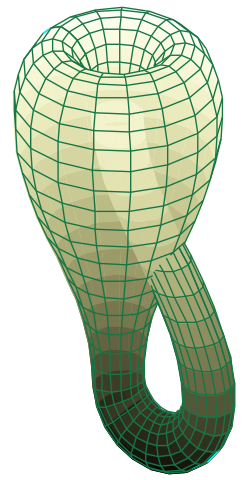
What I’m seeing in the Networked Seminar, however, is more like a Klein Bottle:

Eine Kleine Klein Bottle

which Wikipedia defines as

a non-orientable surface, informally, a surface (a two-dimensional manifold) with no identifiable “inner” and “outer” sides. Other related non-orientable objects include the Möbius strip and the real projective plane. Whereas a Möbius strip is a two-dimensional surface with boundary, a Klein bottle has no boundary. (For comparison, a sphere is an orientable surface with no boundary.)

It’s fair to say that I have little idea what all that means, but “little” does not equal “no,” and the metaphor intrigues me (always has) for the same reason Moebius strips intrigue me, but more so, because the Klein Bottle lets me talk about objects in which the inside is bigger than the outside.

Which is really the point I want to get across here. The networked seminar is not, or not just, a set of nested self-similar iterations of the same idea, though that’s certainly the easiest and most direct mental picture of the initial design. The difference between the babushkas and the networked seminar is that any given point in this augmented human network, one may find that the inner or “smaller” nodes are actually every bit as large as the complete aggregation, and in many cases even larger. As near as I can tell, that’s because every single brain, every single embodied instance of personhood, every single blog post with its language of words and images and sounds and concept structures, can link freely to itself, to other posts in the person’s blog, to other blogs within each local group, to blogs at other local groups, to the portal itself, and of course to the other people represented and enacted by these things, which means that every post can be a kind of portalesque motherblog, and every motherblog can be thought of as a single post, and every person is potentially the entire networked seminar, and any link as well as the entire aggregation can be held in a single thought. I can see this happening in ways that are deeply interesting, even spooky.

Let’s go with spooky.

Last Wednesday I facilitated the Baylor seminar’s discussion of Vannevar Bush’s “As We May Think.” I talked about blogging as a particular genre of, instantiation of, metaphor for, the Memex, particularly with the ways hyperlinks, including the trackbacks they can generate when blogs are linked, are examples of “associative trails.” I thought I’d not spent quite enough time on the essay itself, and too much time on the mechanics of blogging. But then, to my delight, the integration I was trying to get at actually happened over the past week, across multiple levels, because the blogs started coming in across the network in earnest. In fact, folks in our Baylor seminar are all now blogging, and many are now blogging with posts full of links (hyper- and semantic, and is there a difference?) to other blogs. One such blog elicited a comment with its own playful links, which must qualify as some kind of link-jazz.

Further, last week a blogger at the Monterey Institute of International Studies quoted a blogger at the Baylor site. Obviously the MIIS blogger was reading the portal feed, or moving across the motherblogs by means of the networked seminar directory. Ah! And though the link was a quote and not a hyperlink (see how the notion of “link” moves from concept to procedure and back again),  I caught the link myself because I had also been scanning the blog feeds on the portal, and when I read the MIIS blogger’s post I had recognized the quotation (made the connection mentally, so formed/recognized the link). (I confess: when I saw the title was “Nuggets,” I *had* to go take a look. Witness, dear reader, the value of the evocative title.) Now, having incorporated those links into this post, I have folded the mental links and hyperlinks into the entire set of (implicit and explicit) associative trails (and scaffolding) that the blogs are producing within and across all the sites.

Um, whoa.

Then an even spookier thing happened.

Thursday I had the great privilege of facilitating the discussion on Bush’s essay via a Skype connection with the group Tom Haymes is leading at Houston Community College. It was a great discussion, very passionate and insightful, and I found myself quite inspired by it all. Friday, I was scanning the blog feeds to read the HCC blogs about the discussion. Then I clicked over to some of the other sites’ blogs to see what was happening there. Oops! I was brought up short. I thought I’d clicked on a St. Lawrence University blog post. It sure looked like their site. But as I read the post, it was clear to me something had gone wrong. I was reading a description of the discussion at HCC, which had included very thoughtful inquiries into the relationship of information, knowledge, and wisdom. Then I realized that in fact I was reading a description of the HCC discussion–because that’s what they’d talked about at St. Lawrence University as well.

And now my links bear witness to that connection, tell my story of those connections, and enact them anew.

This property of the link–that it is both map and territory–is one I’ve blogged about before (a lucky blog for me, as it elicited three of my Favorite Comments Ever). But now I see something much larger coming into view. Each person enacts the network. At the same time, the network begins to represent and enact the infinities within the persons who make it up. The inside is bigger than the outside. Each part contains the whole, and also contributes to the whole.

Bush’s idea of folded-in-associative-trails gets at this phenomenon, though he doesn’t explore it as fully as I’d like. For me, this folding-within, up and down the scale until scale itself acquires paradoxical meanings, is where the going gets really, really good. I mean quantum good. I also think it’s where Engelbart begins to build his conceptual framework, which for me is a framework about how the inside is bigger than the outside–among many other things, of course. But I’ll save those many other things for the next NMFS blog.

Oh, and here’s the lagniappe. My friend and colleague Tim Logan has a great idea for an NMFS visualization project. I’m going to need some expert help on this one. Tim’s idea is to construct a dynamic map of the thought-connections among the network nodes. I suggested trackbacks (i.e., incoming links) and comments as proxies for these connections. Now all we need is some way to gather the comments-and-trackbacks and have the map automagically trace/draw the connections within and among the sites. Anyone have any ideas for how to do that?

The Network Emerges

As Stu Card remembers it, “There was this thread of ideas that led from Vannevar Bush through J. C. R. Licklider, Doug Engelbart, Ted Nelson, and Alan Kay–a thread in the Ascent of Man. It was like the Holy Grail. We would rationalize our mission according to what Xerox needed, and so on. But whenever we could phrase an idea so that it fell on this path, then suddenly everybody’s eyes would light up, and you’d hit this resonance frequency.”

Mitchell Waldrop, “The Dream Machine: J. C. R. Licklider and the Revolution That Made Computing Personal” (Penguin, 2001), 363.

We’ve now begun the second iteration of our New Media Faculty Development Seminar at Baylor University. Last week was our first meeting: hello, what’s your name, what’s your role, what do you hope to learn this semester, and what’s one thing we should know about you (a “fair warning / full disclosure” moment, for fun)? Turns out the hardest question, both last time and this time, was “what do you hope to learn?” Food for thought there….

As we did our introductions and “disclosures,” I felt the onset of group identity: ah, this is who we are! Several folks in the room knew each other already, several did not. All were intrigued by the mix. I thought I could hear that intrigue growing in their voices as we made our way around the tables. Honors program prof of “literature, media, and learning.” Astrophysicist. Business prof. Recent Baylor graduate. K-12 edtech director. Biologist prof. Rhetoric prof. E-Learning librarian. Classroom technology director. Academic consultant. Seminary prof. Social Work prof. Film studies prof. Sociology grad student. Neuroscience grad student. And on this day, a visitor from a nearby “node” of the networked seminar, sitting in to see how things would start in our Baylor seminar.

A rich mix.

Introductions done, we turned to the shape of the course, with a quick overview of the syllabus and a brief preview of the individual readings we’d be doing together. My goal here was to pique interest and curiosity and thus to stimulate early sign-ups for facilitation slots. It must have worked, as half the seminar had signed up for their first choices by the end of the next day. That said, I did worry that I had spent a bit too much time on the “syllabus tour,” as I could see the late afternoon energy-sag in my colleagues’ expressions, a few glazed eyes, and at least one nodding head (and I don’t mean nodding in assent, either :)).  And I could also feel myself lingering too long on my description of each reading, as I savored the memory of the essays and thought with pleasure about the way this new group would encounter them and make sense of them within the context of their own reading and the group’s discussion.

Time for a break.

Then with about a half-hour left (I need to hire a time manager–whom does Time report to, anyway?), we turned to Janet Murray’s introduction to our text, The New Media Reader. I asked for a “nugget,” by which I mean a passage that was troubling, exhilarating, puzzling, revelatory, whatever. A passage that elicited a strong response of some kind. I find this “call for nuggets” much more effective than “going over” the essay or asking for more general responses. The text is always richer and stranger than any paraphrase can convey. As I glanced around the room, I saw one book filled with highlights. Naturally, I called on that colleague. And was I ever rewarded–or rather, were we ever rewarded. Jim lighted on one of the most interesting passages in the essay, a paragraph in which Murray describes the hopes and anxieties ICT elicits from its users. I asked who else had marked this passage. Several hands flew up around the room. I had a strange feeling, as if I’d suddenly inhabited one of the Kindle’s “popular highlights” moments–or as if the “popular highlights” had tapped into this very moment. And I marveled once again at the ways in which my electronically mediated and face-to-face environments are so thoroughly interwoven. Hopefully, for the good….

All too quickly the session was drawing to an end. After one more Murray nugget from the group, I played Mike Wesch’s immortal “The Machine is Us/ing Us” for the group. A few of us had seen it before, but it seemed to be new to most. As it played, I could sense its power in the room. Certainly I never tire of it. Each time I view it, it seems more witty, heartfelt, complex, and urgent than it did the last time. One of the ATL Grad Fellows said later that she always felt like standing up and cheering at the end. I know that feeling; I share it. In fact, I could feel my teeth chattering with excitement after it was over (yes, that happens to me; I have a little of that “Lloyd Dobler nervous talking thing”). I blurted out something about the wonderful way in which Mike uses the very technologies he’s describing to craft the document he shares with us. One of the seminar participants looked up and asked, “So, would that be a metatext?” Bingo! And off we went on a short tangent about metamedia in which I got to quote my favorite Alan Kay aphorism: “A computer is an instrument whose music is ideas.”

I glanced at the clock and saw we had gone over time by a minute–but I had one more thing to share, something that at that moment seemed the obvious and only way to end the session. I played the clip from the very opening of “The Mother of All Demos,” the one in which Doug Engelbart asks what value we, as knowledge workers, could derive from interacting with our own instantly responsive computers throughout each day. I said, “That question leads directly to Mike Wesch’s video–and beyond. And that path is what we’ll be exploring this semester.”

With that, five minutes over our time, we were done for the day.

And yet not done, either, for the network was emerging. Several blog posts have already come into the Baylor motherblog. Blogs posts are coming online from McClennan Community College, from Houston Community College, from the Monterey Institute of International Studies, from St. Lawrence University, from THE Pennsylvania State University, from the University of Central Florida, from the University of South Carolina Upstate. More sites are coming online this week: Tulane, Case Western, Rice. It’s possible the University of Queensland may join in as well, making this truly an international network. (See the full directory here.)

All these sites will be reading along with us at Baylor, gathering their own local participants’ contributions, feeding aggregated resources into the Networked Seminar Portal, contributing to the podcasts Alan Levine is facilitating along with many other crucial contributions from the New Media Consortium. There’s a discussion forum to elicit conversations and connections among the networked sites–a great place for the larger conversation, which along with the networked groups also includes individual participants from Occidental, Mary Washington, Millersville, Santa Monica College, the Doug Engelbart Institute, and the New Media Consortium.

In my heart, I feel as if the seminar never starts or stops. It continues, and gathers force, and knits many talented, hopeful, and committed learners together into an experience that’s much bigger than any one institution. I don’t know how it will all play out. It’s hard to maintain commitment and energy over twelve weeks. I believe in these readings, though, and the “resonance frequency” they inhabit and excite. I believe in the strong desires of many colleagues to be truly answerable to this extraordinary moment in human history. I believe in what Jerome Bruner calls “the possibilities of communal mental activity.” I believe in real school, and I hope this networked seminar is an instance of it–powerful, and powerfully shared.

I hope it looks, and acts, like the Internet at its best: eyes lighting up, nodes coming online, the network of networks emerging. A complex harmony with the sweet force of one note, pure and easy. A resonance frequency.

Let the music begin.

Thursday’s class, part one

We refer to a way of life in an integrated domain where hunches, cut-and-try, intangibles, and the human “feel for a situation” usefully co-exist with powerful concepts, streamlined terminology and notation, sophisticated methods, and high-powered electronic aids.

I need to blog about my First Year Seminar meeting from last Thursday. I won’t do it justice and I won’t be able at this point even to recreate it well, but I have to try and I have to start. It really was an extraordinary experience, one I’m still marveling at. In the way of all such class meetings, the synergies defy explanation. But at least I can try to relive the sequence of events as best I can, if only as a partial and grateful memorial of that day.

I walked into class on Thursday, September 9, knowing from several of my studentsblog posts that at least some of the students had not found the assignment very interesting or inspiring. I anticipated some resistance to the work we would do together. Nothing unpleasant or disruptive, mind you; these are very polite young men and women, and they’re high achievers, which means they’ve learned how to thrive even when their hearts aren’t in it. (An important skill, to be sure.) Yet I had wished for more, as I always do, particularly in this course, and particularly with this reading assignment: “Augmenting Human Intellect: A Conceptual Framework.” Longtime readers understand how important this essay has been for me. It’s right up there with Frost’s “The Figure A Poem Makes” in my esteem, which is the highest praise I can deliver. Engelbart’s essay changed my life. And while it’s foolish and perhaps dangerous to pin one’s pedagogical hopes on one’s students sharing one’s deepest passions–well, I’m only human, and a foolish one at that, and I always do get my hopes up, despite my maturer cautions.

So I convened the class meeting. We did a little business: log on, greeted our magnificent librarian (who’s not physically in the room, but who’s following along in our Twitter stream), and filled out our Apgars. The class Apgar was low-ish: 6.8 on a 10-point scale. I had challenged the students to bring the average up to an 8 for this epic essay. My heart sank a little more. Still, like the Millennium Falcon, I had a few tricks left in my sweet heart. Time to see if we could make the jump even with uneven crew preparation.

I started with the students’ chief complaints about the essay, most of which centered on Engelbart’s description of his notecards. I gave some historical context, but paid even more attention to the fascinating mixture of humor and incandescent intensity in Engelbart’s prose. Make sure they understand he’s a writer, I told myself. The students began to get interested. They had assumed the essay was straightforward in every respect, so they had missed the drollery, the goofy moments (such as when he uses the charming word “blinko”), the multiply-layered doubling back maneuvers. I asked for passages they’d found confusing, off-putting, strange. Together we began to explore the textures of those passages, their complex tones and arguments, what Bakhtin would call their “internal dramatism”–all of which Engelbart himself acknowledges and celebrates as he writes the essay, inviting us to take a most astonishing and improbable imaginative journey with him as he describes something about our very powers of cognition, description, and communication.

I could feel interest building–there it was, just enough, just enough–and I took the next step I had imagined as I had re-read the essay and prepared for class. Time for the Oxford English Dictionary, and a deep dive into the word “concept,” a word absolutely central to Engelbart’s essay. One might guess that centrality from the title, of course, but the word just sits there so innocently, biding its time: “Augmenting Human Intellect: A Conceptual Framework.” Nothing like the OED, preferably online, to release the strange energies inside those innocent little words. I had deliberately not done the deep dive before class. I knew what was lurking there in that word “concept,” but I didn’t know what words might surround it in the display, or what the OED’s examples might say. I needed to preserve moments of surprise and authentic discovery for the class and for me as well. No discovery in the teacher, no discovery in the students. I was utterly confident of the treasures awaiting us–I knew how rich and strange the word “concept” was–but I didn’t already know what we would find as we made our way through the paths of the OED–and the “not already knowing,” important most of the time, was absolutely crucial on this day.

Suddenly overcome with a wave of nervous energy, I had to pace a little.  I warned the class we were about to go down a very deep rabbit hole where growing echoes of  “curiouser and curiouser” would pursue us all the way to the bottom. I needed to know: were they really ready? Things were about to get very odd, very complex, very puzzling. They were about to learn some mind-altering stuff. Were they really ready?

Yes, Dr. C., we’re ready.

So to the OED we went.

–To Be Continued–