Paul Hester 1959-2005 (Neil Finn Interview Part Three)

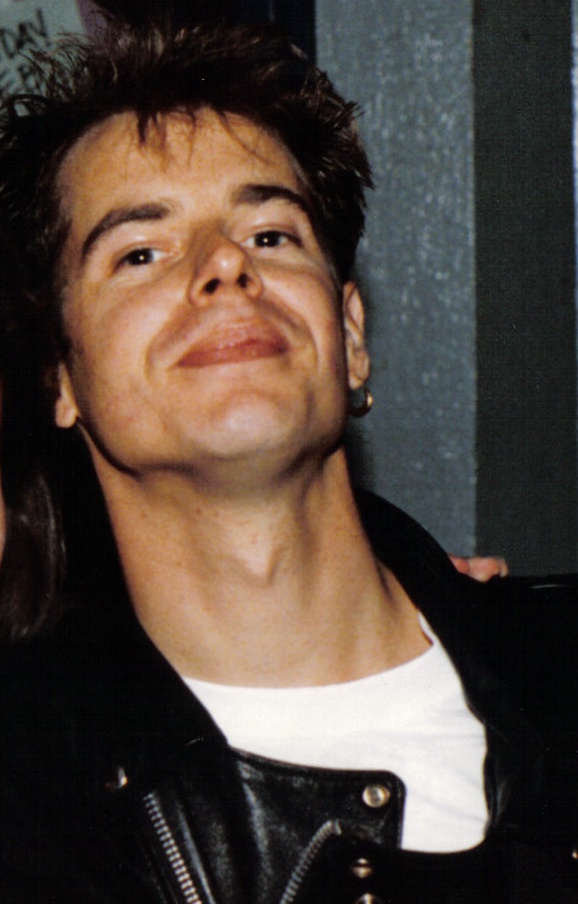
Photo by Nancy J. Price. CC-By-SA http://creativecommons.org/licenses/by-sa/3.0/

This is the third and final part of my 1987 interview with Neil Finn of Crowded House. In this part I ask Neil about “Hole in the River,” a song about his aunt’s suicide. Given the news this weekend that Crowded House drummer Paul Hester took his own life Friday night, Neil’s comments are even more poignant.

I’m dedicating all three of these interview podcasts to Paul and his family. I don’t feel like writing very much more about this tragic event. The podcast has my other comments.

"The Feminine Technique": Tannen on Gender and Discourse

In a recent L. A. Times column, linguist Deborah Tannen explores gender differences in the context of a) the sciences and b) public discourse. I’m not convinced by all of her argument, some of which relies on reductive West vs. East cliches about modes of thought, and some of which extends that easy and misleading dichotomy into similar gender dichotomies. If men and women are significantly different, and the research at this point indicates they are, I don’t think it’s helpful to say one or the other has a “better way.” (I recognize that those words belong to the editor, not Tannen, but they’re a fair inference, at least in the context of Tannen’s discussion of journalism.) It’s also ironic that her very argument relies to some extent on the “agonistic” discourse she’s trying to characterize and counter. That said, Tannen usefully reminds us that rhetoric includes much more than argument, and that discourse may be thoughtful, deeply analytical, and persuasive without presenting itself as a “fight.” And I’m delighted to see that Walter Ong, whom Tannen calls a “cultural linguist,” is a focal point for these ideas.

EDIT: I was so distracted by the gender lead that it was only a few hours later I realized that there was a much more important point in Tannen’s article, one that didn’t really emerge until the end: one isn’t necessarily complicit just because one isn’t attacking. In fact, once the attack has begun, it’s pretty clear that the possible outcomes are few: defeat, victory, or uneasy truce. Tannen’s conclusions remind us that these are not the only possibilities, and that advocates of inquiry and cooperation are not necessarily just “company men” (or women).

Metaphilm


A face-to-face talk with young filmmaker (and former student) Andrew Stone brings cool stuff to light for me today: Metaphilm. I’ve only just glanced at it, but what I’ve seen looks like catnip already. Film lovers, beware. Time to take the phone off the hook (an expression that will be meaningless in five years, if it isn’t already).

On The Road To Ferrum College

I learned many fascinating things today, both on my way to Ferrum College and after my arrival there. I’m at Ferrum to deliver the keynote address for the 2005 Virginia Humanities Conference. My topic is “Tools For Thought: The Humanities In The Age Of Technology,” and my shameless crib from Howard Rheingold’s life-changing work was meant to invoke his spirit, and the spirit of the thinkers he chronicles, as I composed and then delivered my address.

So what did I learn? On the drive down, I learned that Gordon Bell is working on a lifetime personal archive portfolio project that is nothing less than Vannevar Bush’s Memex realized. I learned about Virtual Leader and lessons learned from creating educational simulations. (More to come on that one, since I have found a fellow traveler in the “don’t make the interface transparent” journey I’ve been on for some time.) I learned about NeoNet, a new peer-to-peer technology, and I learned that The Grey Album, probably the most famous mashup to date, was done in two weeks using a cracked Sound Forge Acid download. (Danger Mouse later popped for the legit purchase.) At Ferrum, I learned of Martin Heidegger’s essay on “The Question of Technology,” which I blush beet-red to admit I had not read, but which I am delighted to know about now. Heidegger’s remarks are eerily apt for what I want to say tomorrow, and I’m greatly indebted to Radford University’s Kim Kipling for the citation. The lovely Internet allowed me to become slightly more educated in this area this evening. I will speak under correction tomorrow, as always, but if I understand what Heidegger meant I am more convinced than ever that computer-mediated-communications over the Internet can be profoundly poetic, considered as a emerging whole.

I also learned that the Latin word “copia,” meaning plenty, branches into another meaning by the Middle Ages: transcript. The OED speculates that Latin phrases granting freedom to read or write helped this latter meaning emerge, but I’m haunted this evening by the realization that the God’s plenty provided by our sophisticated tools for thought is etymologically linked to the idea of proliferating exact reproductions.

I apologize for the lack of links in this blog entry. It’s late and I need to sleep, and I’m on my brother’s dialup connection at his apartment in Salem. On the other hand, I grew up in Salem, and I drove by Ferrum regularly on my way to Wake Forest University as an undergraduate there. I love this section of Virginia very deeply and feel both alienated from it and strongly drawn to it, mostly the latter.

Tomorrow right after the address I drive back north to attend a former student’s wedding. A happy day, if the winds are favorable.

The Female Genome

Y and X chromosomesRowan Hooper reports in Wired that researchers at Duke University’s Institute for Genome Sciences and Policy are concluding the human genome is actually two different genomes, one male and one female:

Women (and all female mammals) have two copies of the X chromosome, but the extra copy isn’t needed, and is switched off in a process called X inactivation. Or that’s what scientists thought.
“Our study shows that the inactive X in women is not as silent as we thought,” said co-author Laura Carrel, a molecular biologist at Penn State College of Medicine, in Hershey, Pennsylvania. “The effects of these genes from the inactive X chromosome could explain some of the differences between men and women that aren’t attributable to sex hormones.”

A Conversation with Neil Finn, Part Two

Crowded House First Album

Crowded House's debut album

No time to put together anything very elaborate this evening. (Lucky you.) Here’s part two of the interview. I do regret hounding Neil so much on the Beatles stuff–but only a little, as he was such a good sport and it was fun to talk to a fellow Beatles fan who was so good at using the tradition and not being used by it.

Neil, if you’re out there, you’re a hero in my book. Thanks.

Part three will follow tomorrow or the next day.

A Conversation with Crowded House’s Neil Finn, Part One

Neil Finn

Crowded House was a great band that actually had considerable success worldwide, and that’s pleasant to report. I also like to reflect on when they first emerged in America, in 1986. At the time I was a DJ with a late-night radio show at WWWV, an FM AOR (that’s album-oriented rock for you young ‘uns) radio station in Charlottesville, Virginia, where I was doing graduate work at the University of Virginia. One day program director and afternoon drive-time jock Jay Lopez brought me a 12-inch piece of vinyl from Capitol Records. On it were three songs from a new band called Crowded House. Well, they had me from the downbeat. They sounded like a rootsy version of Squeeze, or maybe an antipodean Beatles around the time of Magical Mystery Tour crossed with a kind of spare, dreamy rock that reminded me of certain Robyn Hitchcock songs. I was an instant fan and played the grooves off that record on my late-night show.

Jay Lopez was a fine DJ and a great guy to work for. He arranged for me to do a phone interview with Crowded House several months later. The album had been out for quite a while by then, but it hadn’t done much in the market. That, however, was about to change: “Don’t Dream It’s Over” had just been released when I did the interview, and of course that song took Crowded House to the top of the charts and made them famous all over the world.

It was a very interesting time, then, to talk to Neil Finn, the songwriter, guitarist, and lead singer for the band. Crowded House had not yet toured the US. Capitol was trying to break the album one more time with a new single. And Neil was in the mood to talk about this wonderful album that not many people knew about yet.

This is part one of three parts I’ll podcast over the next few days. As you’ll hear, there are some goofy radio moments I’ve left in, even though the interview wasn’t aired live. In fact, I edited the goofy stuff at the beginning out of the version I aired. But for the podcast, you get (almost) the whole thing. (There was some nonsense at the beginning when I thought I was talking to Nick Seymour, not Neil, but I’ll save that for the Director’s Cut.) I think the interview holds up pretty well all these years later, and I’m still very moved by how open, warm, and intense Neil was willing to be with a guy he’d never met before.

I hope you enjoy the interview. Here’s part one.

Blowing My Mind: Jon Udell

Consider this an enduring blanket endorsement of Jon Udell’s weblog. His screencast on annotating the planet with a GPS device and Google Maps is amazing. His screencast on how del.icio.us is creating the semantic web right in front of, or should I say, alongside us is amazing. In the two weeks or so I’ve been reading his blog, I’ve had one elating lesson after another.

In the hour or so since I first published this blog entry, after I’d done some sound editing for a new series of podcasts, I did my usual click-around-a-bit interval that typically precedes and follows writing or editing, and I found “Primetime Hypermedia,” a column Jon does for O’Reilly Network, and this behind-the-scenes account of how he put together his Umlaut-Band Wikipedia screencast:

Heavy Metal Umlaut: The Making of the Movie by Jon Udell — Jon Udell explains the process of making a documentary screencast, taking a look at the various screencast genres and examining the potential significance of this medium.

I wrote Jon last week to tell him that he was doing work of extraordinary value for all educators interested in teaching and learning technologies. He wrote back and said I had made his day. Hard to believe, but I was gratified. I just hope I’m not the first or last educator to tell him how much he is contributing to our lives.

I do have one complaint: Udell’s Infoworld blogs don’t accept comments. But his email link works.

Vote "Yes" to NYMary's Podcast

A professor who loves Big Star and all power pop, who corresponds with Steve Simels (one of the great rock critics ever), and who likes the idea of Paradise Lost podcasts. Now, those are impressive credentials. Visit her power pop site and vote “yea” for a NYMary podcast. I”ll be in line with you for number one.

Let Us Now Praise Famous Wikipedians

Is there a Wikipedian National Anthem? Here’s a story in Wired about Power Wikipedians. I prefer to think of that status in the altruistic sense of “powerful givers” rather than the Foucaultian sense of “circulators of power via discourse.” Their mini-bios sure don’t read like those of career “discourse initiators.” (Yes, today is bash-Michel day at Casa Campbell.) Author Daniel Terdiman has this to say about power Wikipedian Stacey Greenstein:

According to Wikipedia’s lists of most active editors, Greenstein made 1,809 edits during the past month. But she thinks that the timing is off and that those numbers refer to the work she did in December. “I suppose knowing that the 1,800 number was wrong says more about me than the fact that I edited 1,800 during some 30-day period.”

Greenstein’s passion in the real world is the same as it is on Wikipedia: fixing things. She is as likely to put misplaced books back in order in a bookstore as she is to correct a Wikipedia article. “I can’t understand why people would take a book off the shelf to see if they like it, and then put it back in the wrong place,” she said.

Greenstein has covered a wide variety of topics. Her favorites are primates and cephalopods, and recently, New York City subways. She considers it her mandate to be as good a Wikipedia citizen as she can, especially as the project has grown up. “I care a great deal about … Wikipedia,” she said. “The concept of ‘freedom to do as we please’ has finally begun its maturation to ‘responsible to do what we need.'”

Could this be the return of the philosopher kings and queens, except that this time anyone who wants to be one need only volunteer for Wikipedia duty?