
Homophone trouble as a parable of learning

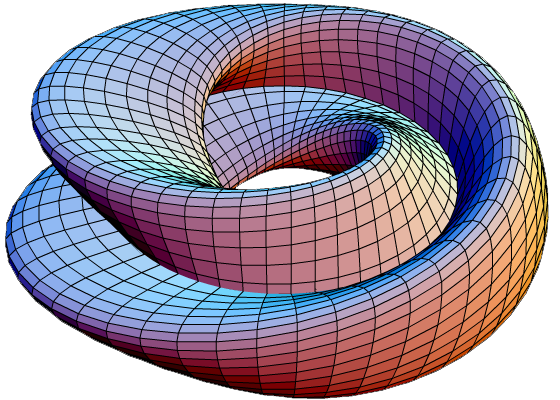
Klein Bottle: obliquity unbounded. Image cc Wikimedia Commons

This one is quite oblique, so if you’re not patient or inquisitive or morbidly curious, this one may not be for you. 

Here’s the backstory. Students in my section of “Living The Dreams: Digital Investigation and Unfettered Minds” are completing their inquiry projects. I’ve been thinking a lot, and emailing a few folks with some frequency, about their drafts. I’ve been thinking about writing and language and how the inquiry’s focus and articulation chart a course for the creator. Along the way, I had the opportunity to interact with one of the students about one of the most difficult homophone (or near-homophone) combos of all: “affect” and “effect.” My email turned into something like one of Vi Hart’s famous “math doodles” (or it seemed so to me). By the end, it felt as if I’d arrived at something near the core of teaching and learning.

I’m confident that what follows is not original with me. The ending, though, is where I think there may be a small contribution. It’s the paragraph that begins “now the interesting thing educationally….”

Unfortunately, the contribution needs to have the homophone discussion for context.

That small contribution draws on Bruner’s “The Will To Learn” as well as Pirsig’s Zen and the Art of Motorcycle Maintenance, the latter of which I am re-reading, as I do about every two years. The whole idea is to find the place where one must stand to start building. The will to learn. The idea or intuition of “quality” that precedes analysis or even conscious experience. The place that makes all possible, and without which we try to run our marathons on broken legs.


Now for the homophone affect-effect problem. You’ve actually got it wrong in your sentence (sorry). Here’s a thumbnail sketch of the differences:affect n. means “emotion.” Example: I could not read his affect from his face.
affect v. means “to adopt in a fake or pretentious way.” Example: She affects a scholarly air.
But now it gets harder.
affected v. *past tense* means “had an effect on” and is often used with the passive voice. (English is a hard language for these and many other reasons. I blame humanity.) Example: “Computing was affected for the better by Engelbart.” It’s a vague verb so I usually try to find a different way to put it. (My typical workaround for linguistic indecision.)
affected adj. means “fake.” Example: He had a very affected manner of speaking.

effect n. means “impact.” An effect is the thing that results from a cause, the thing the cause brings into being. Example: “Engelbart had a great effect on civilization, particularly with regard to computing.”
effect v. means “to bring into being.” Example: “Engelbart effected great change in society.” A vague sentence and not very useful for that reason, but the word is correct. 🙂

So: “The weather affects my mood” and “the weather has an effect on my mood” mean roughly the same thing. “I affect a moody disposition when it rains” means “I put on, or fake, a moody disposition when it rains.” “The weather effects my mood” means “the weather brings my mood into being,” which is not the same thing as “the weather changes my mood.”

Now the interesting thing educationally, for me, is that a) you knew there was a difference and b) you were aware that you may not have understood the difference. The fact that you used “affect” incorrectly is of secondary importance. If those first two conditions didn’t obtain, the incorrect usage would be hard or impossible to address. For decades I have continued to work on instilling the metacognitive loop of 1) and 2) in students without having that loop paralyze their writing. It’s no good trying to get one’s messy thoughts into a rough draft if one gets blocked by linguistic uncertainty. The key is to write and keep writing, then go back and revise later. Eventually one becomes more fluent and can therefore get a lot of this stuff right on the fly, but even then careful proofreading is helpful. I still get my its and it’s wrong in rough drafts, just because I’m going quickly. Same for typos, etc.

Apostrophes? Don’t get me started…. I was laughing with an English friend in Herefordshire several years ago about a sign he saw regarding “Christma’s toys.”

In the end, it’s all conventions, but the conventions matter even though they’re arbitrary. They represent a set of agreements. It’s also kind of fun, in a geeky way, to get it right and to know why–like being able to play a favorite lick on one’s guitar, or being able to draw a recognizable face, or being able to tell a joke well.

Sorry to natter on at such length, but I thought it might be fun to stroll along and think aloud.

All best,
Dr. C.

A research assignment for a radical course

A long time ago, but just up the road, a Shakespeare professor named Bill Kemp and I devised a freshman composition course like no other. Our reader was Stranded: Rock and Roll for a Desert Island. Our syllabus had four assignments, the last of which was a final paper students published to the web. This course began in the fall of 1997. Early days, radical design, extraordinary results. I can’t remember now why we stopped. I guess after six or seven iterations the freshness had turned to slog, and neither of us could bear doing the course unless it was truly magical. I had to teach it by myself at least once, and it was much less fun without Bill. He was my alter ego in many ways, Barfield to my Lewis, Lennon to my McCartney (or perhaps, sometimes, it was the other way ’round). I’ve been meaning for a long time to blog about this course, my first truly open course in the way I’d mean it today. It’s the great-great-grandmother of this summer’s cMOOC, “Living The Dreams.” I learned a great deal by teaching this course with Bill. I learned just as much from my students as well. It really was something very special.

Now we’re closing in on the final weeks of “Living The Dreams,” and I thought I’d reprint the research assignment from the Stranded course. Some of it still seems very fresh to me, and wholly applicable to the kind of research I continue to urge students to do. It’s written Campbell/Kemp because I wrote the lion’s share of it. (Yes, we also had a Lennon-McCartney thing in our heads, or at least I did.) Strangely, the Wikipedia article on research is also quite good, and very well aligned with what Bill and I were trying to do. I’d not looked it up before tonight. Wikipedia continues to instruct and delight.

But back to Stranded. Here’s the assignment. Perhaps it will be useful. To Bill Kemp, my deepest gratitude. I remember our work together with deep satisfaction, even joy. You’re one of a kind.


ENGL 101 Assignment Three: The Research Paper–Campbell/Kemp

Assignment two was about personal engagement in the context of experience. Assignment three is about personal engagement in the context of information and the ideas it contains and inspires. That is, the “research paper” is not a simple “research report”–“What I Learned About Nine Inch Nails.” Instead, like Ellen Willis and Jim Miller and (with reservations) John Rockwell and in fact most of the authors in Stranded, you should incorporate background information and other people’s commentary into your own exploration of the music you’ve chosen to write about.

Research isn’t merely finding a few facts and quotations to back up ideas you’ve already developed. Research is listening to other people, learning from them, and using their ideas to sharpen your own. Think of your sources not as dictionaries or encyclopedias but as places where you can hear a conversation and prepare yourself to join in. Each of your sources, if it’s any good at all, represents a human being who’s done something very like the work you’re now doing. They offer you the results of their work: information, ideas, conclusions. You take what they’ve done and use it to shape, support, and interact with your own ideas and conclusions. Thus the conversation carries on, and we’re all the richer for it.

What is an idea? An idea is a “take” on something. An idea is a frame you generate out of your knowledge and experience (a distinction without a difference) that you use to make a new picture out of something you’ve seen before. Where do ideas come from? They can appear out of the aether, popping into your head–but we can’t always afford to wait for such happy moments. Remember that “chance favors the prepared mind.” Everything is potentially a frame, a source for frames, an idea waiting for YOU to frame it so. Stranded is full of ideas and therefore full of frames. So is every other book worth reading. And if you don’t find a particular frame within someone else’s work, you can certainly learn framing strategies (that is, idea-generating strategies) from other writers. That’s the big reason we read: to find ideas and the story of how our writers discovered them.

Your paper should use the MLA (Modern Language Association) style of documentation, which you may find in The Scott, Foresman Handbook for Writers. Note that MLA now has guidelines for citing online and Internet sources. Also note that Simpson Library has very informative links on their pages, including the essential sections on how to evaluate online sources. Point your browsers to library.mwc.edu/engines.html and take a look at what our wonderful librarians have assembled for you.

Remember: when in doubt about how or where to find sources, ask the reference librarian. When in doubt about how or whether to cite a source, ask your professor. Other guidelines:

  • You should have at least six separate sources on your Works Cited page.

  • At least one of these sources should be a book: either a monograph or a collection of essays. At least four of these sources MUST be print sources or online versions of print sources.

  • You must use at least two Stranded essays in some way. They do not count toward the “six source” total, though they should be cited on the Works Cited page.


THE WISDOM SECTION

Instructions: When you hand in your final draft, hand in this assignment sheet as well. On it, indicate which two of the “bits of wisdom” below you found most helpful, and rank them. Below this section, add at least one bit of wisdom you’d like to pass on to next term’s students.

BITS OF WISDOM FOR THIS ASSIGNMENT:

1. You have a right to be in this conversation. You are a scholar.

2. Tell us what you think, not just what you found.

3. Research is a way to explore your own emotions intelligently, and perhaps to find a friend.

4. It isn’t true just because it’s in print.

5. When in doubt, cite.

6. A thing is psychedelic if it changes when you look at it closely”–Robyn Hitchcock.