Seven Wonders, Vannevar Bush, and NMFS_F10

Thanks to Alice for the image. <3

I’ve actually seen Cinerama, real Cinerama, at one of the few places left on Earth that’s got the synchronized projectors, the skilled technicians, and an actual Cinerama print to show. The three-screen Cinerama process was expensive. The machinery was finicky. The logistics pretty fierce. As a result, Cinerama never really caught on, despite the splendors of movies like How The West Was Won. But if you travel to Bradford and get to the museum on the right day, you can see what all the fuss was about. And you can join in the continuing celebration.

What I’m witnessing as we begin the third week of the New Media Faculty Development Seminar leaves Cinerama, breathtaking and beautiful as it is, in the dust. (And I don’t say that idly–I loved This Is Cinerama when I saw it in Bradford in 2000.)

I’m not going to be able to knit my thoughts into anything very elegant or polished. I’m feeling rather awestruck by the network, by the beautiful patterns of response emerging from it on a daily basis. The most obvious place to see those patterns is the Netvibes portal, one great place to get the comprehensive view of the activity generated by the network (and the network generated by the activity).

But the portal is only one of the wonders. Another is that the every node in the network, seen with the digital imagination, is also potentially a great place to get the comprehensive view.  I wish I had superitalics to stress this point even more emphatically. The fractal, network-of-networks model doesn’t just follow a paradigm in which sets of unitary-simple-examples aggregate into a highly complex set-of-sets that retains features of each set and each element in each set. It does something far more rich and strange.

Let me try to explain. You know babushkas? Here’s a picture from the Wikipedia article:

Women amid the flowers

This design is pretty easy to understand, and accords well with our sense that in the physical world, small things go inside bigger things. That’s the key to the Maggie Sort Algorithm, too:

What I’m seeing in the Networked Seminar, however, is more like a Klein Bottle:

Eine Kleine Klein Bottle

which Wikipedia defines as

a non-orientable surface, informally, a surface (a two-dimensional manifold) with no identifiable “inner” and “outer” sides. Other related non-orientable objects include the Möbius strip and the real projective plane. Whereas a Möbius strip is a two-dimensional surface with boundary, a Klein bottle has no boundary. (For comparison, a sphere is an orientable surface with no boundary.)

It’s fair to say that I have little idea what all that means, but “little” does not equal “no,” and the metaphor intrigues me (always has) for the same reason Moebius strips intrigue me, but more so, because the Klein Bottle lets me talk about objects in which the inside is bigger than the outside.

Which is really the point I want to get across here. The networked seminar is not, or not just, a set of nested self-similar iterations of the same idea, though that’s certainly the easiest and most direct mental picture of the initial design. The difference between the babushkas and the networked seminar is that any given point in this augmented human network, one may find that the inner or “smaller” nodes are actually every bit as large as the complete aggregation, and in many cases even larger. As near as I can tell, that’s because every single brain, every single embodied instance of personhood, every single blog post with its language of words and images and sounds and concept structures, can link freely to itself, to other posts in the person’s blog, to other blogs within each local group, to blogs at other local groups, to the portal itself, and of course to the other people represented and enacted by these things, which means that every post can be a kind of portalesque motherblog, and every motherblog can be thought of as a single post, and every person is potentially the entire networked seminar, and any link as well as the entire aggregation can be held in a single thought. I can see this happening in ways that are deeply interesting, even spooky.

Let’s go with spooky.

Last Wednesday I facilitated the Baylor seminar’s discussion of Vannevar Bush’s “As We May Think.” I talked about blogging as a particular genre of, instantiation of, metaphor for, the Memex, particularly with the ways hyperlinks, including the trackbacks they can generate when blogs are linked, are examples of “associative trails.” I thought I’d not spent quite enough time on the essay itself, and too much time on the mechanics of blogging. But then, to my delight, the integration I was trying to get at actually happened over the past week, across multiple levels, because the blogs started coming in across the network in earnest. In fact, folks in our Baylor seminar are all now blogging, and many are now blogging with posts full of links (hyper- and semantic, and is there a difference?) to other blogs. One such blog elicited a comment with its own playful links, which must qualify as some kind of link-jazz.

Further, last week a blogger at the Monterey Institute of International Studies quoted a blogger at the Baylor site. Obviously the MIIS blogger was reading the portal feed, or moving across the motherblogs by means of the networked seminar directory. Ah! And though the link was a quote and not a hyperlink (see how the notion of “link” moves from concept to procedure and back again),  I caught the link myself because I had also been scanning the blog feeds on the portal, and when I read the MIIS blogger’s post I had recognized the quotation (made the connection mentally, so formed/recognized the link). (I confess: when I saw the title was “Nuggets,” I *had* to go take a look. Witness, dear reader, the value of the evocative title.) Now, having incorporated those links into this post, I have folded the mental links and hyperlinks into the entire set of (implicit and explicit) associative trails (and scaffolding) that the blogs are producing within and across all the sites.

Um, whoa.

Then an even spookier thing happened.

Thursday I had the great privilege of facilitating the discussion on Bush’s essay via a Skype connection with the group Tom Haymes is leading at Houston Community College. It was a great discussion, very passionate and insightful, and I found myself quite inspired by it all. Friday, I was scanning the blog feeds to read the HCC blogs about the discussion. Then I clicked over to some of the other sites’ blogs to see what was happening there. Oops! I was brought up short. I thought I’d clicked on a St. Lawrence University blog post. It sure looked like their site. But as I read the post, it was clear to me something had gone wrong. I was reading a description of the discussion at HCC, which had included very thoughtful inquiries into the relationship of information, knowledge, and wisdom. Then I realized that in fact I was reading a description of the HCC discussion–because that’s what they’d talked about at St. Lawrence University as well.

And now my links bear witness to that connection, tell my story of those connections, and enact them anew.

This property of the link–that it is both map and territory–is one I’ve blogged about before (a lucky blog for me, as it elicited three of my Favorite Comments Ever). But now I see something much larger coming into view. Each person enacts the network. At the same time, the network begins to represent and enact the infinities within the persons who make it up. The inside is bigger than the outside. Each part contains the whole, and also contributes to the whole.

Bush’s idea of folded-in-associative-trails gets at this phenomenon, though he doesn’t explore it as fully as I’d like. For me, this folding-within, up and down the scale until scale itself acquires paradoxical meanings, is where the going gets really, really good. I mean quantum good. I also think it’s where Engelbart begins to build his conceptual framework, which for me is a framework about how the inside is bigger than the outside–among many other things, of course. But I’ll save those many other things for the next NMFS blog.

Oh, and here’s the lagniappe. My friend and colleague Tim Logan has a great idea for an NMFS visualization project. I’m going to need some expert help on this one. Tim’s idea is to construct a dynamic map of the thought-connections among the network nodes. I suggested trackbacks (i.e., incoming links) and comments as proxies for these connections. Now all we need is some way to gather the comments-and-trackbacks and have the map automagically trace/draw the connections within and among the sites. Anyone have any ideas for how to do that?

The Network Emerges

As Stu Card remembers it, “There was this thread of ideas that led from Vannevar Bush through J. C. R. Licklider, Doug Engelbart, Ted Nelson, and Alan Kay–a thread in the Ascent of Man. It was like the Holy Grail. We would rationalize our mission according to what Xerox needed, and so on. But whenever we could phrase an idea so that it fell on this path, then suddenly everybody’s eyes would light up, and you’d hit this resonance frequency.”

Mitchell Waldrop, “The Dream Machine: J. C. R. Licklider and the Revolution That Made Computing Personal” (Penguin, 2001), 363.

We’ve now begun the second iteration of our New Media Faculty Development Seminar at Baylor University. Last week was our first meeting: hello, what’s your name, what’s your role, what do you hope to learn this semester, and what’s one thing we should know about you (a “fair warning / full disclosure” moment, for fun)? Turns out the hardest question, both last time and this time, was “what do you hope to learn?” Food for thought there….

As we did our introductions and “disclosures,” I felt the onset of group identity: ah, this is who we are! Several folks in the room knew each other already, several did not. All were intrigued by the mix. I thought I could hear that intrigue growing in their voices as we made our way around the tables. Honors program prof of “literature, media, and learning.” Astrophysicist. Business prof. Recent Baylor graduate. K-12 edtech director. Biologist prof. Rhetoric prof. E-Learning librarian. Classroom technology director. Academic consultant. Seminary prof. Social Work prof. Film studies prof. Sociology grad student. Neuroscience grad student. And on this day, a visitor from a nearby “node” of the networked seminar, sitting in to see how things would start in our Baylor seminar.

A rich mix.

Introductions done, we turned to the shape of the course, with a quick overview of the syllabus and a brief preview of the individual readings we’d be doing together. My goal here was to pique interest and curiosity and thus to stimulate early sign-ups for facilitation slots. It must have worked, as half the seminar had signed up for their first choices by the end of the next day. That said, I did worry that I had spent a bit too much time on the “syllabus tour,” as I could see the late afternoon energy-sag in my colleagues’ expressions, a few glazed eyes, and at least one nodding head (and I don’t mean nodding in assent, either :)).  And I could also feel myself lingering too long on my description of each reading, as I savored the memory of the essays and thought with pleasure about the way this new group would encounter them and make sense of them within the context of their own reading and the group’s discussion.

Time for a break.

Then with about a half-hour left (I need to hire a time manager–whom does Time report to, anyway?), we turned to Janet Murray’s introduction to our text, The New Media Reader. I asked for a “nugget,” by which I mean a passage that was troubling, exhilarating, puzzling, revelatory, whatever. A passage that elicited a strong response of some kind. I find this “call for nuggets” much more effective than “going over” the essay or asking for more general responses. The text is always richer and stranger than any paraphrase can convey. As I glanced around the room, I saw one book filled with highlights. Naturally, I called on that colleague. And was I ever rewarded–or rather, were we ever rewarded. Jim lighted on one of the most interesting passages in the essay, a paragraph in which Murray describes the hopes and anxieties ICT elicits from its users. I asked who else had marked this passage. Several hands flew up around the room. I had a strange feeling, as if I’d suddenly inhabited one of the Kindle’s “popular highlights” moments–or as if the “popular highlights” had tapped into this very moment. And I marveled once again at the ways in which my electronically mediated and face-to-face environments are so thoroughly interwoven. Hopefully, for the good….

All too quickly the session was drawing to an end. After one more Murray nugget from the group, I played Mike Wesch’s immortal “The Machine is Us/ing Us” for the group. A few of us had seen it before, but it seemed to be new to most. As it played, I could sense its power in the room. Certainly I never tire of it. Each time I view it, it seems more witty, heartfelt, complex, and urgent than it did the last time. One of the ATL Grad Fellows said later that she always felt like standing up and cheering at the end. I know that feeling; I share it. In fact, I could feel my teeth chattering with excitement after it was over (yes, that happens to me; I have a little of that “Lloyd Dobler nervous talking thing”). I blurted out something about the wonderful way in which Mike uses the very technologies he’s describing to craft the document he shares with us. One of the seminar participants looked up and asked, “So, would that be a metatext?” Bingo! And off we went on a short tangent about metamedia in which I got to quote my favorite Alan Kay aphorism: “A computer is an instrument whose music is ideas.”

I glanced at the clock and saw we had gone over time by a minute–but I had one more thing to share, something that at that moment seemed the obvious and only way to end the session. I played the clip from the very opening of “The Mother of All Demos,” the one in which Doug Engelbart asks what value we, as knowledge workers, could derive from interacting with our own instantly responsive computers throughout each day. I said, “That question leads directly to Mike Wesch’s video–and beyond. And that path is what we’ll be exploring this semester.”

With that, five minutes over our time, we were done for the day.

And yet not done, either, for the network was emerging. Several blog posts have already come into the Baylor motherblog. Blogs posts are coming online from McClennan Community College, from Houston Community College, from the Monterey Institute of International Studies, from St. Lawrence University, from THE Pennsylvania State University, from the University of Central Florida, from the University of South Carolina Upstate. More sites are coming online this week: Tulane, Case Western, Rice. It’s possible the University of Queensland may join in as well, making this truly an international network. (See the full directory here.)

All these sites will be reading along with us at Baylor, gathering their own local participants’ contributions, feeding aggregated resources into the Networked Seminar Portal, contributing to the podcasts Alan Levine is facilitating along with many other crucial contributions from the New Media Consortium. There’s a discussion forum to elicit conversations and connections among the networked sites–a great place for the larger conversation, which along with the networked groups also includes individual participants from Occidental, Mary Washington, Millersville, Santa Monica College, the Doug Engelbart Institute, and the New Media Consortium.

In my heart, I feel as if the seminar never starts or stops. It continues, and gathers force, and knits many talented, hopeful, and committed learners together into an experience that’s much bigger than any one institution. I don’t know how it will all play out. It’s hard to maintain commitment and energy over twelve weeks. I believe in these readings, though, and the “resonance frequency” they inhabit and excite. I believe in the strong desires of many colleagues to be truly answerable to this extraordinary moment in human history. I believe in what Jerome Bruner calls “the possibilities of communal mental activity.” I believe in real school, and I hope this networked seminar is an instance of it–powerful, and powerfully shared.

I hope it looks, and acts, like the Internet at its best: eyes lighting up, nodes coming online, the network of networks emerging. A complex harmony with the sweet force of one note, pure and easy. A resonance frequency.

Let the music begin.

Thursday’s class, part one

We refer to a way of life in an integrated domain where hunches, cut-and-try, intangibles, and the human “feel for a situation” usefully co-exist with powerful concepts, streamlined terminology and notation, sophisticated methods, and high-powered electronic aids.

I need to blog about my First Year Seminar meeting from last Thursday. I won’t do it justice and I won’t be able at this point even to recreate it well, but I have to try and I have to start. It really was an extraordinary experience, one I’m still marveling at. In the way of all such class meetings, the synergies defy explanation. But at least I can try to relive the sequence of events as best I can, if only as a partial and grateful memorial of that day.

I walked into class on Thursday, September 9, knowing from several of my studentsblog posts that at least some of the students had not found the assignment very interesting or inspiring. I anticipated some resistance to the work we would do together. Nothing unpleasant or disruptive, mind you; these are very polite young men and women, and they’re high achievers, which means they’ve learned how to thrive even when their hearts aren’t in it. (An important skill, to be sure.) Yet I had wished for more, as I always do, particularly in this course, and particularly with this reading assignment: “Augmenting Human Intellect: A Conceptual Framework.” Longtime readers understand how important this essay has been for me. It’s right up there with Frost’s “The Figure A Poem Makes” in my esteem, which is the highest praise I can deliver. Engelbart’s essay changed my life. And while it’s foolish and perhaps dangerous to pin one’s pedagogical hopes on one’s students sharing one’s deepest passions–well, I’m only human, and a foolish one at that, and I always do get my hopes up, despite my maturer cautions.

So I convened the class meeting. We did a little business: log on, greeted our magnificent librarian (who’s not physically in the room, but who’s following along in our Twitter stream), and filled out our Apgars. The class Apgar was low-ish: 6.8 on a 10-point scale. I had challenged the students to bring the average up to an 8 for this epic essay. My heart sank a little more. Still, like the Millennium Falcon, I had a few tricks left in my sweet heart. Time to see if we could make the jump even with uneven crew preparation.

I started with the students’ chief complaints about the essay, most of which centered on Engelbart’s description of his notecards. I gave some historical context, but paid even more attention to the fascinating mixture of humor and incandescent intensity in Engelbart’s prose. Make sure they understand he’s a writer, I told myself. The students began to get interested. They had assumed the essay was straightforward in every respect, so they had missed the drollery, the goofy moments (such as when he uses the charming word “blinko”), the multiply-layered doubling back maneuvers. I asked for passages they’d found confusing, off-putting, strange. Together we began to explore the textures of those passages, their complex tones and arguments, what Bakhtin would call their “internal dramatism”–all of which Engelbart himself acknowledges and celebrates as he writes the essay, inviting us to take a most astonishing and improbable imaginative journey with him as he describes something about our very powers of cognition, description, and communication.

I could feel interest building–there it was, just enough, just enough–and I took the next step I had imagined as I had re-read the essay and prepared for class. Time for the Oxford English Dictionary, and a deep dive into the word “concept,” a word absolutely central to Engelbart’s essay. One might guess that centrality from the title, of course, but the word just sits there so innocently, biding its time: “Augmenting Human Intellect: A Conceptual Framework.” Nothing like the OED, preferably online, to release the strange energies inside those innocent little words. I had deliberately not done the deep dive before class. I knew what was lurking there in that word “concept,” but I didn’t know what words might surround it in the display, or what the OED’s examples might say. I needed to preserve moments of surprise and authentic discovery for the class and for me as well. No discovery in the teacher, no discovery in the students. I was utterly confident of the treasures awaiting us–I knew how rich and strange the word “concept” was–but I didn’t already know what we would find as we made our way through the paths of the OED–and the “not already knowing,” important most of the time, was absolutely crucial on this day.

Suddenly overcome with a wave of nervous energy, I had to pace a little.  I warned the class we were about to go down a very deep rabbit hole where growing echoes of  “curiouser and curiouser” would pursue us all the way to the bottom. I needed to know: were they really ready? Things were about to get very odd, very complex, very puzzling. They were about to learn some mind-altering stuff. Were they really ready?

Yes, Dr. C., we’re ready.

So to the OED we went.

–To Be Continued–

Integrative Learning and the Gift of New Media: General Education for the 21st Century

Necker Cube
How to move from “general education” to “generalizable education.” That problem was the thread running through my keynote presentation at Benedictine University last March. Dr. Wilson Chen and the Benedictine General Education Task Force kindly invited me to speak to the way information and communication technologies could inform a revised general education curriculum–and, by implication, speak to what endures, what changes, and can be radically improved in higher education as a result of this revolution.

My answers came obliquely, as they typically do. (They come that way to me, so it’s only honest and fair to express them that way as well. At least, that’s what I tell myself.) In this case, I was obsessed with the idea of changing “general education” to “generalizable education.” Instead of what Tim Clydesdale calls the “liberal arts hazing” that first-year students “endure” (see his book The First Year Out for this chilling description) as they bounce from intro survey to intro survey, getting their general education like shots at a clinic, why don’t we explore the richly integrative possibilities of a truly generalizable education, an experience that stresses the kind of learning that stimulates persistent cross-domain thinking and imagining. Why not build a “general education” out of immersive, compelling experiences of analogy-making? My main inspiration was a book by Douglas Hofstadter called Fluid Concepts and Creative Analogies. (My thanks to Jon Udell for turning me on to this book–it’s his favorite Hofstadter, and I can well understand why.) The book is entirely too rich for any summary to do it justice, but suffice it to say that Hofstadter takes Polya’s How To Solve It to a meta-meta level, in which disciplined cognitive procedures thoroughly informed by embodied, thick-context experience and observation leads to a certain “reframing” ability, what Hofstadter describes as a “Necker Cube” operation in which the cube can face out or in, depending on how one flips one’s perspective. To be able to perform such cognitive operations, not in a random way, but in a way guided by reason *and* intuition is, it seems to me, what we mean when we talk about “critical thinking”–and more. My thoughts are obviously indebted to Michael Wesch’s idea of moving from “knowledgeable” to “knowledge-able,” though I hope the particular case of general education–in which the idea of becoming truly knowledgeable is a non-starter–explores another angle of his complex argument. The idea of generalizability, as it came to me from Hofstadter, is also important, I think, for the idea of general education as integrative. And of course ICT is for me the meta-platform that, properly framed and built, is almost pure integrative potential. One of the Benedictine U folks asked me if my ideas suggested that majors should come in the first two years of one’s college career, with general education of the kind I was advocating becoming a capstone experience, not an introductory experience. I thought that was a brilliant idea, and I still do. What a breathtakingly risky undertaking that would be, to turn the curriculum on its head! Yet how rewarding to follow concentrated studies in a particular discipline with an increasingly integrative set of generalizable courses.

These are not particular cogent or illuminating remarks, I fear. I hope the talk itself is more lucid. The recording isn’t pristine, and the ideas are as always a work in progress–but hopefully the results will spark some thoughts in other folks, and lead us all together to something more than any of us could achieve on our own. Keep in touch, and let me know. My thanks to all the good folks at Benedictine for a truly wonderful, inspiring visit. I couldn’t have asked for better hosts, or more dedicated colleagues.

Oh yes: here are the slides as well.

Digital Citizenship

In honor of Jim Groom, who did some astonishing work at Baylor over the last few days, I’m going to try to pick up the pace a bit….

Two weeks ago I was a respondent and workgroup facilitator for the 2010 Campus Technology Executive Summit in Boston, Mass. In my respondent role, I did a very short presentation speaking to the subject Susan Metros of USC was addressing. My presentation was titled “Digital Citizenship,” a phrase that I did not invent but which I’ve been working with, and on, for the last few months. I’m trying to get to the next steps after digital fluency, the steps that might finally inform an entire curriculum. I started with a little album of YouTube videos illustrating the varieties of instruction on this website:

I picked these because they were all different, and all rigorous in their own ways. All posed vigorous challenges to our typical school practices of teaching, writing, and learning. Here are the slides that I used after the video to try to tease apart some of the suggestive layers within each example, layers that led in turn to my larger points.

A work in progress.

Backlash whiplash: should we dump the term “PLN”?

Flickr photo by merry heart. CC Attribution-NonCommercial-ShareAlike 2.0

Responding to Alan Levine’s post (be sure to check out his links and the comment stream):

If the phrase “personal learning network,” or “PLN” (guess that makes me Dr. Evil), has really become CLICHE then I’m happy to drop the term. But I don’t think it has, or should. I’ll take the words in order.

Why does it matter that it’s personal? Because for many people, the only learning network they think about is school, and school is typically not very personal–at least, it’s not something we feel we should be personally responsible for constructing for ourselves. Educators make our schools for us, and we go there to consume an education, work hard, get good grades, get our degrees. Yet I’d say that the deepest engagement with education comes only when we act as if we really are bringing the learning network into being, ourselves, every day–just as every course should write itself into being. So “personal” implies “personal construction and personal responsibility,” not just ownership and right of use, which is why the analogy with cars and hammers doesn’t work for me. (When I wrote my piece on “a personal cyberinfrastructure,” I was thinking along these same lines: we are the web, the machine is us, and the best way to get the best out of that macro-cyberinfrastructure is to practice building our own on its platform.)

Why does “learning” matter? Why not just “network”? Because that word “network” gets used for lots of things, not just for deliberately self-directed learning. My network consists of friends, birds-of-a-feather, various information resources, etc. My *learning* network is my personal suite of trusted and inspiring experts. That’s not the same as the folks I share experiences and interests with, though the two may (actually, do) overlap.

(Digression: I miss the energies of 2005 and 2006, when so much of this conversation was exploratory instead of polarized and polarizing. That polarity is one of the reasons I’m finding it difficult to blog these days. Though I understand both are valuable, I like exploring more than arguing. While everyone else debates Beatles vs. Stones, the lads themselves are sharing a good time at the Scotch of St. James–while still enjoying their rivalry.)

So I think all three words in PLN are important, and that their biggest value is that they suggest deliberate actions that don’t depend on someone else’s curriculum, degree program, or institution. Not just the open web, though it’s the open web that makes them possible–and that’s why the word “network” is vital as well.

That said, it’s the wrangling and the seemingly inevitable hype cycle for these terms that really get me down. I remember all those arguments about “Web 2.0”: it is real, it’s not real, it’s hype, it’s O’Reilly branding, etc. etc. In my experience, Web 2.0 is a useful concept that has its limits, just like a bunch of other useful concepts (actually, they all have their limits, don’t they?). And believe it or not, I still talk to rooms of faculty where half or more of them haven’t heard the term, let alone the ideas it represents. Sometimes I think intensity of the edtech community makes us forget that the things we argue about or abandon are still news to lots of folks and have a lot of good left to do.

P.S. I don’t know what a TLA is. I’m also iffy on CBDs, TYAs, ORCs, JUTs, and KWEs. But I am curious. Maybe I should ping my PLN.

P.P.S. Whatever my PLN is, it’s not a Nixty, at least so far as I can see. On this count Alan and I are in total agreement.

From Accreditation to Standards and Excellence: New Media Leading Academic Change

More from the 2010 NMC annual meeting last month in Anaheim. These are fairly rough notes, but rather than trying to make them into a more finished narrative, I’ve decided that there’s a play of voices here that can stand on its own. A few of my own interjections emerge here and there, in parentheses, representing thoughts at the time and thoughts somewhat later. What I remember most vividly about this session in retrospect is not necessarily anything we decided or any consensus reached, but rather how extraordinarily moving the conversation became as we went along. We are indeed united by our passion. We care about the potential for computers, for the Internet, for richly mediated human interaction as engines for the augmentation of human intellect. That caring is difficult to sustain within many typical educational practices and organizational realities, many of which are either indifferent or openly hostile to these ideas and this potential.

As Janet Murray asks, how long before we recognize the gift for what it is? In many respects, this session wrestled and dreamed with the hope of answering Murray’s question, and the goal of honoring and fostering the recognition more widely.


Getting started on day two of the NMC annual conference with a town hall meeting: NMC members are responding to NMC’s emerging investigation into possibilities for accrediting New Media programs at colleges and universities. To begin, Cornell’s Joan Getman, chair of the NMC’s Commission on Standards and Excellence, recaps the April San Antonio meeting and summarizes the conclusions, most of which turned out–usefully, in my opinion–to be questions about values and meaning. I’m impressed by Joan’s summary, its the clarity and faithfulness to the experience. (I was there on the last day.) I look forward to reading them in the NMC monograph that will come out of the April meeting and subsequent discussions.

Larry Johnson picks up the discussion here, talking about Rachel Smith’s visualizations of the April discussions, telling the story of the experience through these remarkable drawings. The drawings are online, and I urge you to consult them to get a sense of the rich texture of the discussion.

At this point in the conversation we begin to try to define New Media. A difficult and interesting moment. A member from Australia cites interactive design, use of electronic tools, research abilities in a cross-disciplinary research design with critical media studies work, and the foundations of education terminology and theory. A colleague from Wisconsin sees New Media as a great equalizer, a way to bring the disabled into society, an avenue for participation that might otherwise be lost. Another colleague says New Media is about agency and generativity. Yet another colleague speaks to New Media’s emphasis on storytelling and rich contexts. A colleague from UT-Austin describes New Media as “a field that combines the arts and sciences to communicate human experience.” Another voice: New Media is about innovative thinking, forward thinking, thinking that leads to new research and new methodologies. New Media makes the invisible visible, very powerfully.

Larry points out that the field of New Media is mature, twenty years old. That’s part of why we feel this need to bring more specificity and focus to our work. (At the same time, the generativity of New Media constantly works against this codification–a fascinating tension.)

A colleague from England speaks to his work in new literacies. The word “new” implies an opposition to old media, and raises the question of when something new becomes old. At a higher level, we see that all human experience is mediated. New Media implies a paradigm shift in how we view this mediation, and how we conceive knowledge to be constructed and shared.

And what about the toolkit, one voice asks? The toolkit changes all the time, but the end is the constant of human experience and its expression. Another voice helpfully adds that we also value a certain attitude toward the tools, a set of expectations regarding creativity and the possibility (indeed, the necessity) of innovation.

And what of old media? Do we reject old media? Far from it, Mike Berman suggests, pointing to Rachel’s visualization of the discussion as a wonderful example of analog, “old media” expression, not all that different from the cave paintings.

Another question: what experiences *are* New Media? Is SMS still “new media”? Perhaps NMC’s Horizon Report can lead the way here: the newness is at the horizon, at the leading edge. (“Horizon Media”? An intriguing possibility.)

From Maricopa Community Colleges: New Media is about digital literacy, teaching people to drive cars, not drive Fords. Preparation for transport, not for a particular brand of automobile.

And a very poignant suggestion arises: can we define New Media in words? Perhaps we must define New Media by using New Media. (My heart beats faster at this suggestion, I confess. I find it bold and inspiring.)

Yet another fascinating suggestion: perhaps work in New Media combines both research and application. (This idea maps well onto The New Media Reader’s suggestion that New Media unites making and knowing, techne and episteme. In that same volume, Janet Murray writes eloquently of the braided interplay of cultural expression and technical innovation at the end of the twentieth century–braided interplay, which Ted Nelson might also call “intertwingling.)

Larry asks why we’re interested in New Media. “Toys!” a person shouts out from the back of the room. “Imagination,” another adds. These “toys” empower children to enter the conversation. For all of us, the tools empower tinkering–we use these tools to commit art. (I think of Seymour Papert and the “children’s machine”–how much of the history of New Media has focused on education, especially on early childhood development.)

More thoughts now, coming faster (the question obviously taps into some deep wells of emotion): The field has dreamers and outcasts–the field enables us to be the misfits, successfully. New Media builds a subculture. New Media also bridges the new and old cultures, and allows communication between the rising generation and the older generation. This is a profoundly human activity, one that generates innovation and rewards imagination. New Media also fills in the gaps between imagination and communication. New Media helps us make information digestible. Think also about SF: the children have extraordinary learning opportunities in science fiction. The Star Trek holodeck is a tremendous learning technology, a tremendous learning environment. Arts and Sciences have become ossified and do not embody our current knowledge of what we are and what we’re capable of. New Media is a field, a structure, a community that can embrace scientific methodologies as well as artistic practices and possibilities. It also generates respect for intellectual diversity, and perhaps generates enough big picture thinking to lead to something as ambitious and apparently out-of-reach as world peace. New Media gives us the chance to hear voices we would not otherwise hear–the voice now speaking cites Joe Lambert and the Center for Digital Storytelling as sterling examples. And a voice adds that “transparency in the use of the technology” leads him to fascination with New Media, which focuses on the expression even more than the tool.

So now the question is, “what is excellence?” Bryan Alexander offers three ideas. 1. Future scanning: methods of looking forward. 2. Awareness of copyright, including an appreciation and celebration of fair use (dammit, he adds), 3. Storytelling. Another voice speaks up: the willingness to admit we don’t have all the answers. Ruben Puentedera adds: an awareness of the history of the field, the thinking involved in getting to that point. I contribute a thought born of years within the profession of English studies:

What of assessment? What of the end user? What of innovation defined in terms of the strengths and abilities of individual students? The new objects of study–do we really intend web science as our focus? Can we set aside some of what we value as we search for this focus?

Another person emphasizes the need for not only copyright but also citation, giving proper acknowledgement to the works we use and alter. Works cited: a hallmark of an excellent program, with a rich sense of rigorous scholarship. We also need to be mindful of the professionalism we seek to prepare, an important connection with the corporate world in which many of our students will be working. We also need to use New Media to help teach the skills and values of collaboration. And then there is Henry Jenkins’ concept of transmedia, an exciting way of thinking about the new media landscape and the cultural products that emerge from that landscape.

Larry closes with a look forward to a monograph coming out in the early fall, a catalyst to continue this conversation about accreditation/standards and excellence for new media programs at colleges and universities. There’s a wiki where you can add to this conversation. We hope to craft a process that embodies the values we hope to promote.

Practicing our values. Walking the new media walk–with our eyes on the horizon.

Practical Suggestions

Steve Greenlaw over at Pedablogy said very nice things about the preceding post, and I’m grateful. Moreover, I want to show my gratitude. But Steve asks for practical suggestions. You’d think we’d just met. Have I ever given him practical suggestions? Well, okay, perhaps once or twice. I do try. Actually, I thought I had put some practical suggestions into the preceding post. Yet I suppose it all came out the way it does most of the time. What he gets from me is what everyone gets: dreams and myths and song lyrics and movie quotations and cryptic mutterings about this and that delivered with mournful looks or hand-waving manic excitement. Steve’s patient with my cryptic mutterings. I do try to save some of my best ones for him.

So here are some mythy dreamy non-practical practical suggestions, by semi-request, in honor of Pedablogy’s fifth birthday (back in May; I’m late).
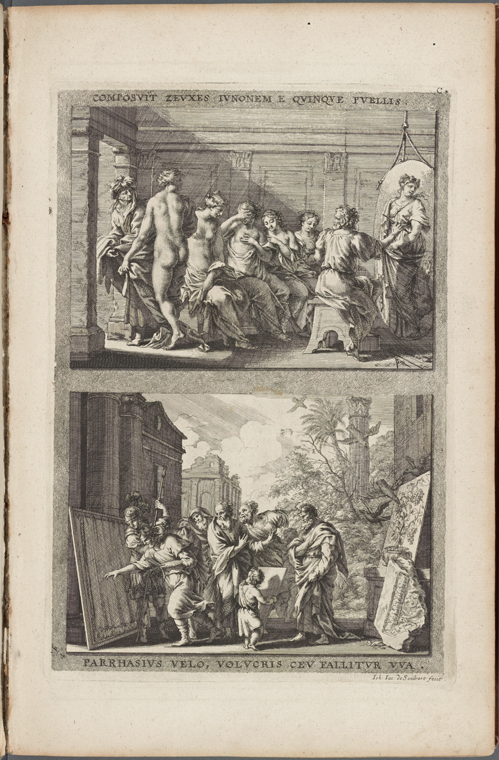
The contest is depicted in the lower panel.

I’m fascinated by the tale Pliny the Elder tells of  a contest between two Greek painters, Zeuxis and Parrhasios.[i] (I’m using it right now in a Milton article I’m trying to write.) Which of these painters could craft the most compelling representation? The word “representation” is important here. These paintings were made to imitate visible reality, and the extent to which they tricked the eye (thus “trompe l’oeil”) would determine their success. With a century and a half of technological image capture behind us, we may ourselves judge such a contest as aesthetically unsophisticated, yet the story as Pliny tells it has deep resonance for all lovers of poetry and symbolism. I think it has deep implications for teachers and students as well. What motivates interest? What representations of knowledge, in the moment of learning facilitated by a teacher, inspire curiosity?

Zeuxis shows his painting first. He removes the cover from the canvas, to reveal a painting of a bunch of grapes. The grapes’ verisimilitude delights the crowd, and the audience responds with praise. Yet an even more persuasive endorsement is near, as several birds swoop down to the painting to peck at the grapes, so complete is the representation, so powerful is the illusion. One might at that point judge the contest decided. If the natural world itself is fooled by a representation is such a direct way, uncolored by subjectivity, the representation is essentially perfect. I’d link this perfect representation to an utterly clear, well-organized set of descriptive information presented to students as if teacher, classroom, and student were all blank canvases ready to receive the crystalline perfection of the precise and authoritative exposition of the subject matter. (Not that there’s anything wrong with that, in the Seinfeldian sense.)

But the contest has another layer of perfection to be revealed. I’ll quote directly from the translated text of Pliny’s Natural History:

Parrhasios then displayed a picture of a linen curtain, realistic to such a degree that Zeuxis, elated by the verdict of the birds, cried out that now at last his rival must draw the curtain and show his picture. On discovering his mistake he surrendered the prize to Parrhasios, admitting candidly that he had deceived the birds, while Parrhasios had deluded [Zeuxis] himself, a painter.

That moment is for me a parable of engagement, of the kind of hungry interest that can drive a learner both faster and deeper than anyone might imagine. Zeuxis’ cry begins the experience. In some senses it defines the experience. It’s a complex moment: something great is at stake for him, and the event has already brought him a considerable triumph. We can think about the ways in which one can construct the drama of the learning moment, and how one can bring some experience of elation to any learner at any level. The deepest bit for me, though, is that urge to lift the veil. The urge has little to do with crystalline clarity of exposition. And it has everything to do with interest. I felt that urge when I went to college. I was a first-generation college student, working class, ready to find a more comprehensive sense of the mystery and complexity of the world and learn to articulate it for myself. Many teachers who work with similar students report they are “hungry” for an education. Encountering a student with that hunger, and helping that student find the food that will both satisfy and increase that hunger, is one of the great and humbling rewards of being a teacher.

But what to do with the students who, like the one Steve describes in this post, are simply not hungry, who announce (with pride? defiance? boredom?) that they have no interest in the subject being taught? And what of those students who are hungry, but who have had their interest quashed by teachers who may well be interested in their own interest but have not learned to be interested in their students’ interest, to be fascinated by the growing fascination with areas that may be “old hat” for the teacher but feel like radical innovation, even revelation to the student?

I suppose that’s my cue for practical suggestions. I think these work for all three types of students I’ve described above. They’re all about making a veil–really, a kind of meta-representation–that elicits a cry for revelation.

1. Practice being visibly interested in your students’ interest. (Go meta; Google recursion (H.T. to Tim Logan)). Watch them like a hawk for any flicker of curiosity, confusion, or awe. Don’t pounce, but do attend, and let them know that you find their interest fascinating, or at least potentially fascinating. This requires top-notch listening skills, patience with digression, and the steely discipline not to look down, away, or at your watch/cell phone/class clock/notes whatever. There has to be a rhythm here, of course. If you’re hanging on their every gesture, students will a) not believe it and b) begin to find you rather creepy. You also don’t want to pander to them by suggesting everything they say is right, deep, astonishing, etc. What I’m suggesting here isn’t really about praise, however. It’s more about finding their interest interesting, and letting them know that. You can tell them when they’re wrong, misguided, etc. What’s not good is to miss the signs of interest, or to ask merely for repeated information (though that has its place, a steady diet is pretty deadening), or employ a kind of mock-interest merely as a way to use their contributions to take you to the next step in your own well-laid instructional plan. The latter strategy is perilously easy to spot. Next thing you know, the students will be feigning interest right back at you, and then the jig is up for everyone.

2. If  you can connect your interest in their interest to your interest in the subject matter, you’re actually demonstrating a vivid human and social context for the life of the mind. That context is, I believe, one of the primary reasons for school in the first place–not that you’d know it from some of the last century’s industrial strategies, some of which people are trying even now to sustain in this century as well.

3. Include robust portions of the conjectures and dilemmas that drive your particular areas of intellectual concern and the methodologies that drive your inquiries into those areas (in other words, your discipline). Searching through my blog archives, I see that I’ve invoked Jerome Bruner’s idea of  “conjectures and dilemmas” many times without actually quoting the wonderful story with which he illustrates his concept. I will now correct that oversight! A long quotation follows. Trust me: it’s worth it.

There are several quite straightforward ways of stimulating problem solving. One is to train teachers to want it, and that will come in time. But teachers can be encouraged to like it, interestingly enough, by providing them and their children with materials and lessons that permit legitimate problem solving  and permit the teacher to recognize it. For exercises with such materials create an atmosphere by treating things as instances of what might have occurred rather than simply as what did occur. Let me illustrate by a concrete instance. A fifth grade class was working on the organization of a baboon troop–on this particular day, specifically on how they might protect against predators. They saw a brief sequence of film in which six or seven adult males go forward to intimidate and hold off three cheetahs. The teacher asked what the baboons had done to keep the cheetahs off, and there ensued a lively discussion of how the dominant adult males, by showing their formidable mouthful of teeth and making threatening gestures, had turned the trick. A boy raised a tentative hand and asked whether cheetahs always attacked together. Yes, though a single cheetah sometimes followed behind a moving troop and picked off an older, weakened straggler or an unwary, straying juvenile. “Well, what if there were four cheetahs and two of them attacked from behind and two from in front. What would the baboons do then? The question could have been answered empirically and the inquiry ended. Cheetahs don’t attack that way, and so we don’t know what baboons might do. Fortunately, it was not. For the question opens up the deep issues of what might be and why it isn’t. Is there a necessary relation between predators and prey that share a common ecological niche? Must their encounters have a “sporting chance” outcome? It is such conjecture, in this case quite unanswerable, that produces rational, self-consciously problem-finding behavior so crucial to the growth of intellectual power. Given the materials, given some background and encouragement, teachers like it as much as the students.

To isolate the major difficulty, then, I would say that while a body of knowledge is given life and direction by the conjectures and dilemmas that brought it into being and sustained its growth, pupils who are being taught often do not have a corresponding sense of conjecture and dilemma. The task of a currculum maker and teacher is to provide exercises and occasions for its nurturing. If one only thinks of materials and content, one can all too easily overlook the problem.

Quoted from Jerome Bruner, Toward A Theory of Instruction (Harvard Univ. Press, 1966), 158-159.

“Life and direction” are good eye-catchers–and good I-catchers, too. A caution: one should not confuse the teaching of conjectures and dilemmas with “teaching the conflicts” (as Gerald Graff urged us to do at the zenith of the era of high-theory epistemological panic), which in my view has real but highly limited value. Demonstrating that people have different opinions. judgments, points of view, foundational assumptions, etc. may take some very sheltered students by surprise, which is its real value: it inculcates a certain kind of tough-mindedness. But it’s not a conjecture, nor is it a dilemma. A conjecture is what Bruner calls an “invented” answer, not a “found answer,” and of course original thought doesn’t not proceed by merely looking up answers that are already there. And a dilemma is “a problem offering at least two solutions or possibilities, of which none is practically acceptable” (Wikipedia). In my experience, “teaching the conflicts” never gets to the conjectures that inevitably emerge from incomplete data or the dilemmas that emerge when one takes conjecture and incomplete data and nonetheless feels compelled to act or reason in one way or another.

4. Everett Rogers argues that observability is a major factor in the diffusion of innovation. I believe that this argument works for interest as well. Interest spreads when it’s observable. How can students observe each other’s interest? Well, one way is to have everyone sit in a circle, where a circle is defined as everyone’s being able to see everyone else. (Many “circles” fail this test, in my experience. I always insist on it, and I clown and cajole until I get it.) Another way is to play a game, one in which the players’ interest and engagement are readily visible and drive the entire experience upward in terms of its intensity and fascination (my colleague Blaine McCormick does this with a game in his intro marketing class). Yet another way is to create a visualization of individual expressions of interest, both in and out of the class meeting, and make that visualization available to the class and (this is important) to the world as well. We teachers feel pretty good when students say they’re interested in the classes we teach, but what we really want, I think, is for students to be interested in what the class is about, what it represents in the life of inquiring minds around the world, what this one course and one semester stand for more largely and importantly. For that to happen, there must be ample provision for displaying student reflection (e.g. blogs), resource collection (e.g. Delicious, Flickr), and in-class thinking (e.g. Twitter) to the world. It’s one thing to tell students that the local class meeting has lifelong, global, even eternal significance. It’s another thing altogether to connect to the global network and raise the possibility of contact and interaction with that field of larger significance (i.e., civilization). Who will read my blog? Is it possible that nearly anyone in the world might? Whether or not a miracle comment from an expert, an alum, a parent, another classmate ever emerges, the tantalizing possibility of that contact lends urgency and a bracing sense of expectation to the work and its aggregation. Ditto for Delicious: students see on the motherblog, or in their reader, or wherever, that their classmates are thinking about the class when the class isn’t meeting. One might imagine such a thing happening, but something as simple as an RSS feed in a sidebar will demonstrate that fact–and the observability of that demonstration of ongoing interest will drive more interest. At every juncture, then, we must think of ways not only to elicit and nurture interest, but to make the aggregated display of the students’ interest into an object of interest itself, thus perpetuating a most virtuous cycle. We will find ways to make interest go viral–and “we” in this case primarily means “the students themselves”–but only if their individual work, as appropriate,  is visible to the entire class and, as appropriate (which is more often than not), to the world.

I never intend to write these elephantine posts. But having “wreathed my lithe proboscis” yet again, with my Jumbo apologies any my hopes that something in all of the above is useful, perhaps even practical, I take my leave with a quotation from Steve’s very first blog post at Pedablogy–what I’d call the most practical suggestion of all:

I’m writing this blog primarily for myself. For years I’ve had stray thoughts that I have wanted to think through, but ended up slipping away. I’ve decided to let this blog be the place for me to think through those thoughts.

Rock on, brother, and amen.


[i] My source for this episode from Pliny’s Natural History is The Elder Pliny’s Chapters on the History of Art, translated by K. Jex-Blake (Chicago: Ares Publishers Inc., 1977), 109-111.

Interest: the Primum Mobile?

“The Primum Mobile, the largest and swiftest sphere in Dante’s cosmology, is the physical origin of life, motion, and time in the Aristotelian-Ptolemaic universe.”

Image and caption from “Danteworlds,” a beautiful and deeply imaginative website at the University of Texas at Austin.

Sometimes I feel as if we’re all arguing about local traffic ordinances when we should be working together to craft a bicameral legislature and a three-branch system of government with the appropriate checks and balances. Or that we might really want to talk about varieties of representative government more generally–or is it more specifically? All the leadership training and experience I’ve had over the last six years has made me instinctively reach for that strategic layer–which also, and increasingly, feels like a foundation. Strange trick of perception there, depending on the cosmology perhaps.

So I hear and participate in lots of talk about educational innovation and, more urgently, educational reform. And I keep reaching for that foundational layer. Or is it the strategic layer? Either way, it’s a sine qua non: if we’re not talking about that layer, it really doesn’t matter much what else we are talking about. But finding that layer, that’s not so easy. It’s either dreamy or impractical or too complex or too obvious and simple. No wonder it’s so elusive.

Today, I want to entertain the idea that the strategic foundation for learning is interest, a particular kind of intrinsic motivation that manifests as openness to new ideas, a willingness to be in conversation, a genuine reaching-out to the unfamiliar and sometimes even the daunting or repellent. A penchant for wanting to know. A habit of inquiry. A disposition to wonder.

Thanks to Hillary Blakeley, our founding Graduate Fellow in the Academy for Teaching and Learning, and Ellen Filgo, Baylor’s E-Learning Librarian, I feel as if I’m standing on a hill overlooking a vast new land to explore, as they have brought me resources on curiosity and interest that even at the outset seem to me to be vital starting and ending points for thinking about learning.The in-betweens matter, of course; they’re crucial. But I’m suspecting that the idea and experience of interest–my own, my friends’, my colleagues’, my students’, especially as the experience (not necessarily the object) of interest is shared–is at the center of what I call real school.

The other day, Ellen sent me some links to Paul Silvia’s work on interest. Silvia, a cognitive psychologist at the University of North Carolina at Greensboro, is already teaching me a ton. From him I’m learning that there’s a great deal of evidence to suggest that interest is not just a state of mind. Rather, interest is an emotion. I’m not joking when I say that this idea thrills me, and begins to radiate explanatory power through a lot of what I’ve been thinking and dreaming about for decades. It also resonates quite strongly with my favorite description of the poet John Donne, by another poet, T.S. Eliot:

For Donne, a thought was an experience. It modified his sensibility.

It sounds basic, obvious, simplistic even, to say that interest is at the heart of self-directed, intrinsically motivated learning. Yet Silvia, and much of the work he cites, demonstrates that interest is far from simple, and that acquiring the ability to make something interesting to oneself is one of the highest metacognitive capacities we can develop. My fascination continues as I learn about Silvia’s work on metrics for curiosity (now there’s an authentic assessment for liberal learning: has this curriculum made you more interested in the world around you, and if so, how?) and about his extensive writings on interest and aesthetics. I’m seeing that “interest” is not necessarily “passing” or “mild” or otherwise superficial. At its most intense, interest is directly linked to peak experience, to “flow.”

Yes, perhaps my greatest pedagogical interest will turn out to be the experience and sharing of interest itself. Perhaps my feedback loops, my recursions, my motherblogs, and all the rest are efforts to turn what JSB calls “curiosity amplifiers” into “interest engines” or even “interest viruses” that spread like wildfire through the learning community as the interest (or engagement) streams are made visible and themselves become an object of interest, or of meta-interest. And perhaps the fascinating spectacle of shared interests and the shared experience of interest will also inspire one of the other “knowledge emotions” Silvia studies, and I treasure beyond the telling (and suspect he does too): awe.

I’ll leave you with a great little nugget (that’s my word for those resonant passages) from Silvia’s 2006 book Exploring the Psychology of Interest, one that reminds me of Eliot’s description of Donne, and of W. H. Auden’s observation that a teacher must also be a clown:

People who must create feelings of interest–entertainers, teachers, writers, artists, magicians, and beleaguered babysitters, to name a few–need to know how to manipulate the emotions of other people. This requires understanding the dynamics of emotional experience.

A word to the Kindle tribe: I’m annoyed (to put it very mildly) that the Oxford University Press discounts the 59.95 print version by only 20% for the Kindle version. University presses ought to get wise about e-books, if only to build market share. Books like these could appeal to a much wider readership than psychology professionals. But against this vexing reality is the lovely surprise of the sample download (aren’t you downloading free samples for your Kindle app, on whatever devices you wish?), which is quite substantial and will no doubt lead to a sale in the near future.

Bonus round: Paul Silvia has made much of his scholarly work available on his website. [EDIT: fixed the link on June 11, 2026. Perhaps Dr. Silvia would consider a self-hosted website? Just a thought. I’m just grateful he’s still on the web, and so copiously. And I am grateful I got to meet him and say my thank-yous several years ago when he visited VCU for a Humanities Center talk.]

Easter egg: Today I learned that one of our new ATL Grad Fellows (and an alumna of our New Media Faculty Development Seminar), Megan Johnson, is a fan of Silvia’s work. Megan is herself a doctoral candidate in psychology, so of course I feel quite affirmed by her professional endorsement. 🙂 And I’m looking forward to some intensely interesting conversations to follow.

Representation, Demonstration, and the Digital Imagination

I often quote Jon Udell’s principle of the “conservation of keystrokes,” so I was pleased to see his particularly acute and insightful blog post on the principle behind the principle. As is often the case with Jon’s writing, I found my mind moving to one of JSB’s “adjacencies” as I read along, triggered by the anecdote of how folks didn’t “get” Lotus Notes. The telephony demo story is perfect, and points to what I’m thinking is the real difficulty here with understanding the principle behind the principle: the imagination.

Presenting the telephony demo on a stage is as heroic in its way as trying to represent four-dimensional space on a piece of paper. You really are about two dimensions down. So when I talk to my colleagues about narration, curation, and sharing–or to use Jon’s words,  discover, share and reuse (the trio that I hope we can train digital citizens to grok by emphasizing narration, curation, and sharing in the curriculum)–I’m really trying to suggest multiple dimensions that simply aren’t visible, except by a leap of the imagination, through the suggestive abstractions I use in the demo. I call them “suggestive abstractions,” but of course they look to me like case studies, because I’ve actually seen them work, because I participate daily in those modes of communication, and because I know other teachers/writers/artists etc. who have also had these experiences. Yet these real-life examples, testimonials, and so forth that are not only real to me but indeed hyper-real (multiple puns intended) end up not answering the question “why would you want to do that?” And they don’t answer that question because the way I imagine what *that* is ends up diverging in some fairly stark ways from the way my audience imagines what *that* is (let’s say for brevity’s sake that we both call *that* “education,” or more accurately perhaps, “school”). I demonstrate the uses of blogs in the classroom, or urge student work be showcased on YouTube, or whatever, and it’s like demonstrating telephony on a stage. Folks see it, and understand it, but they don’t understand the dimensions that make it compelling, because those dimensions cannot be revealed to witnesses examining a process on a stage.

But there’s the (meta) rub. I’ve had the experience I’ve had with these tools and online writing spaces because my imagination led me to those experiences. A long time ago, I could intuit what they were about. When I began reading Engelbart, et al., I found sublime and complex articulations of that intuition, and I’ve had an amazing intellectual journey since then. But the intuition came first. Lately I’ve been re-reading some of the science fiction I read as a kid. (Brain Wave is the latest: horribly dated in some respects, but in others an eerie parable of mental amplification that has strong resonances with our current situation.) Is that where it came from? Or did the intuitions lead me to science fiction? Who knows? The real question is whether that intuition can be awakened or strengthened in others. I believe it can. But only the imagination can lead there and beyond. Otherwise, it’s just tool adoption, with the predicable backlashes and ineffectualities.

Then the question becomes how to build, inspire, provoke, or otherwise empower the digital imagination. It’s a question of meaning, in some respects, like the move from signs to words and their semantic potential. It’s also, I think, a matter of watching other intellectuals try to work through these questions as they imagined the digital age to come. That’s a big reason why I’m excited about the New Media Faculty Development seminar that the Baylor Academy for Teaching and Learning facilitated last spring, a project we’re repeating this fall (more on this soon). We didn’t do it by ourselves: we had enormous help from Alan Levine and the New Media Consortium, and we had thoughtful, serious, and open participants from several sectors of Baylor University, including the Baylor Interdisciplinary Core. There were many happy convergences. But it all had to do with the imagination.

Most people in the seminar have told me that it was enjoyable and meaningful for them. It may not have worked for everyone, but for one example of where it did (I know there are others), this seminar participant’s reflections suggest that our readings and conversations did help to awaken and strengthen the digital imagination, and that there is a layer beneath–or above–what Jon calls the “tech churn,” a layer that may help us see the four-dimensional (or n-dimensional) worlds that are implicit, and for some of us lived and inspiring realities, in the line drawings of a network.