Building a new table: a response to John Fritz’s response

From "How To Build A Table." Click on the image to see the original website.

Hi John–thanks for stopping by and leaving such a long and thoughtful comment. Yes indeed, you should be blogging, man!  I’d read it, and I’d link to it, too. The blogosphere’s magical that way. Just saying. So here’s my response. Next time, I hope there’s a blog on your end so I can do some pingbackin’. Srsly.

First, thanks for the kind words about my leadership. One clarification: I’m currently Chair of the Board of Directors of the NMC. To say I’m “Chair of the NMC” makes my role sound bigger than it really is. Also, while I do hope I’m making some valuable contributions to the conversation about higher education, I take greatest pride and satisfaction in the students I’ve worked with over the years. I estimate, conservatively, that I’ve had over 3500 students come through my classes since I began teaching full-time back in 1990. I’ve tried to pay attention to what worked and what didn’t in the courses I led. I hope one of my own “instructor effects” was to encourage my students to take responsibility for their own learning, just as you say. But even there, I find, there’s an art to this endeavor, mostly in the manner and contexts in which I as a teacher try to encourage my students. I’m constantly thinking about the effect my best instructors had on me, and constantly trying to weave that into the tapestry of my own teacherly imagination. I had some utterly magnificent teachers. They were all different, except for the clear dedication they all showed to helping me find and nurture my best self. In my own journey, I keep trying to make myself worthy of the love (sometimes tough love) and commitment they gave to me.

I’m thrilled, of course, to hear of the successes of problem- and challenge-based learning in the introductory CHEM courses. This is great news in an area that sorely needs it. Of course it’s a great thing when a problem is noticed, the extent of the problem is demonstrated, and a solution is found. I’m not anti-research or anti-numbers by any means (and neither was Carl Brigham). In the talk I gave at the Fashion Institute of Technology last January, I had fairly sharp words for some of my Miltonist colleagues regarding their unhelpful sneers at quantitative data in the humanities. I so wish I were a neuroscientist–at least, one like Hillary Blakeley. 🙂 My own “APGAR for Class Meetings” is a quantitative metric, and every day I used it I would calculate mean, median, and mode in front of the students–because it was fun, and because it offered three different portraits of how well the class had prepared. Is that analytics? If so, fine. But I understood “analytics” to mean something more specific, something along the lines of “business intelligence for academia”–a kind of data-mining of narrowly defined and measured behaviors in students, behaviors that as you note are only proxies for what we’re trying to investigate (and in my view, dangerously misleading proxies). *That* kind of analytics I have serious concerns about, as I’ve already explained in my blog posts. Are those data entirely useless? No. Do they carry the great risk of making mistaken assumptions about learning seem to be “facts”? Yes. When Chris Dede says our assumptions about learning are fundamentally flawed, what light does that shed on these questions? Yes, we know that time on task correlates well with better grades in most circumstances. But what tasks? And to what end? No offense to David Wiley, who’s done fine work in open education,  but I confess I was not delighted with that waterfall. I was, however, greatly nourished by Randy Bass’s presentation on “the problem of learning in the post-course era,” which analyzed the complexities of cognition much more successfully, in my view, especially in the light of our current cultural moment.

You say that my critique is widening. I don’t think so. I think the species of what I object to are proliferating, but they belong to the same genus.  What I object to, as I’ve explained, is a move away from cognitive and social approaches to learning and assessment, and a move toward more behaviorist models. I don’t object to course web sites. I object to the idea of “learning management,” just as I object to the widespread adoption of get-em-through Computer Aided Instruction, for all the reasons Ted Nelson outlines in “Computer Lib / Dream Machines.” I think people adopt behaviorist and “learning management” models because they yield more easily quantified results (the research is more focused, less messy, and thus more “convincing”) and can drive institutional decision-making more readily. These are not good reasons. These are reasons not connected with learning, at least as I understand the process. People may adopt them with the best of intentions, and genuinely care about student welfare. But in my view they’re also risking premature standardization and a kind of self-validating meaninglessness. In the midst of the “largest increase in expressive capability in the history of the human race” (Shirky), Blackboard demonstrated that what too many folks in higher education really wanted was a closed, neat, easily monitored environment that would preserve the worst of the transactional elements of education. These systems used to be called “course management systems,” but that wasn’t grand enough for Blackboard, so they became a “learning system” and then tried to assert (as I understand it) that they owned the patent on assigning different roles and permissions to various participants in a website.  EDUCAUSE itself protested when Blackboard sued Desire2Learn, a courageous stance given all the parties that Blackboard has helped to fund over the years.

I think a password-protected course website that helps to manage documents within a course has its uses, though I’d never say that such a site “manages” learning. I don’t think learning can be “managed”–as I’ve explained in my posts, it’s the wrong metaphor, and it does matter what we call things. What I see, though, is that such websites *become* the online presence for every aspect of the course, and thus furnish data on “student involvement” that form the basis for “analytics” that measure with fantastic precision an activity that occurs within, and perpetuates, a brutally reductive paradigm of learning. Some of my faculty colleagues resist working online because they’re Luddites or mulish or whatever, sure. (And faculty mulishness has its good side, too, though that rarely gets discussed.) But I also have colleagues who resist working online because “working online” means “using a ‘learning management system.'” Once they understand the other possibilities open to them, they get interested. Cole Camplese and the folks at PSU are exploring those other possibilities in ways I too admire. A large part of what I admire comes from their willingness to build within non-management paradigms of learning and expression. Obviously UMW Blogs is also leading in this area (and has also been an inspiration for PSU, as Cole will tell you himself).

Student cynicism about school breaks my heart, because that cynicism (except for the strongest, most rebellious of them) becomes cynicism about their own lives. Yet what I hear when I talk to students these days is a tremendous amount of cynicism. They know the game. They know the drill. Their “attention” is focused, all right; it’s focused on “getting through.” Stockholm syndrome comes next.

To cite Papert again: “Before the computer changed school, school changed the computer.” If you want to know why we haven’t gotten to the honeymoon (or even first base), that’s why. The promise of teaching and learning technologies, for me, involves changes in how we think about school. I’ve documented my thoughts in this area pretty widely over the last few years, so I won’t repeat them here. I’m not sure how to answer your question about my D or F students. I have had a few of those students, sure, and I try my best to reach them. I want all my students to succeed, to grow as learners and to attain the cognitive fluency that comes from hard work with intellection (which includes memory), experimentation, and articulation. The richness you kindly describe in my presentations comes from that desire, and the students’ answering commitment. I’m not sure what the control group would be for my “R&D,” or that it’d be ethical for me to design a class that deliberately impoverished the learning experience so I could get harder evidence of the effectiveness of my methods and the work we do together. (To be fair, I don’t think you’re asking me to do that–but the “control group” is a perennial problem in experimental design in education.)  I do know that I am regularly astonished by the quality and intensity of work students can do when they stop trying to “figure out what the teacher wants” and learn that the teacher wants them to be their best selves in a particular learning context. If you want more specifics on how to teach a huge intro-level course with those goals in mind, Mike Wesch would be the one to talk to. I’ve learned a huge amount from him, and I am particularly grateful for the example he sets of stubbornly insisting that the right kind of “instructor effect” can make a huge difference.

"Noise Professor" Zachary Dowell's cover for a book I keep trying to write....

When I starting talking about “love analytics” during an interview at ELI 2011, I was thinking of Mike’s beautiful story of his wife’s telling him to love his students and they would love him back. I am also inspired by what Mike has been saying about Erich Fromm’s book on the art of loving as a teaching/learning paradigm. Mike’s a social scientist who’s not skittish at all about data of any kind. But like James Fernandez and Grant McCracken, Mike foregrounds creativity as a mode of knowing, and has no truck with what Fernandez memorably calls “administered intellectuality.” Mike is also demonstrating how we as educators might come to grips with the principle of plenitude that Plato described long ago, a principle at the heart of transformative learning. Here’s how McCracken memorably imagines what might happen if Plato were alive today:

Plato, let’s say, returns to walk among us.   He becomes, inevitably, a figure of  controversy.  The talk show circuit demands his presence.  (“Today on Geraldo:  Plato—architect of Western culture or dead white male?  You decide!”)  There are doubts, of course.  Production assistants do not warm to elderly men who must be talked out of the wonder-struck examination of a parking meter.  (“You’re telling me any citizen may make a claim against this space by inserting a coin?  That there’s an implicit contract between the ‘motorist’ and other members of the polis?”)

But Plato is not entirely astonished by the contemporary world.  He has seen some aspects of our world before.  He would have no difficulty, for instance, with the blooming, buzzing quality of contemporary life.  He wouldn’t blink at poetry too diverse for a common theme or fashion dizzy with pluralism

Plato accepted the world as a place that bloomed and buzzed….

(Grant McCracken, Plenitude 2.0, Book One of Culture By Commotion. Available as a free “drafty book” download here. Don’t miss what McCracken says about “drafty books” at the end, as it’s the sort of thing Kathleen Fitzpatrick, HASTAC, NMC, and others have been working on in other emerging forms of scholarly communication. Also, God save me from such “production assistants” as McCracken describes above–and also from ever becoming one myself.)

If  “analytics” means trying to assess whether something has worked or not, of course I’m fine with that–as long as we keep the questions of “what is that ‘something’?” and “what do we mean by ‘worked’?” and “are our measures really adequate to what we want to know?” as rich and complex as they need to be. From what I see and hear, that’s not happening. A disturbing amount of the talk I’ve heard about “analytics” simply ignores those rich and complex necessities. You write, “Higher ed needs to get more students through successfully.” Through what? And what constitutes success? The getting through? That seems to me like a tautology. You write, “we need evidence, not anecdotes of instructional technology’s effectiveness to get a seat at the resource allocation table.” I love the word “anecdote.” It’s such a polite cuss word. 🙂 What about a learner’s self-report? An auto-ethnography? A work like Papert’s that tells the story of his own journey as a learner–this, mind you, a mathematician’s journey, a mathematician of the highest caliber who spent most of his career working on computers and education at MIT? Are these “anecdotes”?

Really, if the stories of transformative learning are not admissible evidence at the “resource allocation table,” then maybe we need to get our tools together and build a new table.

Learning, invention, greatness

Norbert Wiener

I came across a striking sentence yesterday in one of the books I’m reading, Norbert Wiener’s Invention: The Care and Feeding of Ideas.

For a great period of invention, the artisans must become philosophers or the philosophers, artisans.

I think Wiener is right, and I have several thoughts following that statement:

  • The moments of insight that characterize deep learning have, for the learner, the flavor, feel, and energy of invention. In other words, when learners “realize” something, they do not simply memorize the connection that the teacher has made for them. They feel, and rightly feel, that they have made this connection themselves–which means they feel as if they themselves have invented the idea or connection. The arts of intellectual seduction (as Bruner puts it) are closely linked to the arts of temptation and elicited curiosity, not as a mode of pandering to students, but in simple acknowledgement of the fact that the “a ha” moment does not mean “a ha, now I see what you have shown me” (though one may use such words) but “a ha, I have made a breakthrough, I have invented a new thing.” Of course the learner may or may not have “invented a new thing.” If not, then of course the learner should credit other learners and not cherish the illusion that he or she has in fact invented the wheel. But it is the feeling of having done so that matters, and that separates the pursuit of insight from mere studiousness. It’s important to have the discipline to be studious, but it’s more important to understand that every moment of deep learning feels to the learner like an innovation or an invention, and (thus) to frame the learning experience in such a way as to make that experience more likely. Repeat-after-me is antithetical to the experience of insight or innovation, though it may be a useful stage of preparation, especially if it’s in the context of play, not scolding. Otherwise, as Wiener writes (with the masculine pronoun that, alas, reflects 1954’s biases), “the scholar-workman is bound to a perpetual subordination to a prearranged order of things.” (Sounds rather like our current “curricular” strategies that culminate in “learning management” and teaching-to-the-test, but I digress.) Weirdly, I find that many people seem to think the feeling of invention I’m describing is relevant only to a) mavericks or b) very gifted students (and to the combination of a and b, of course). My argument is that this feeling of invention characterizes all deep learning, and is therefore relevant to all learners; all learning experiences should be designed and carried out with this in mind.
  • The artisan/philosopher connection is at the heart of what we think and talk about in the New Media Faculty-Staff Development Seminar.  As the editors of The New Media Reader put it:  “Understanding new media is almost impossible for those who aren’t actively involved in the experience of new media; for deep understanding, actually creating new media projects is essential to grasping their workings and poetics.” Or as Richard Feynman said, “What I cannot create, I do not understand.” Or as Alan Levine insists, it’s all about being there, and creating out of that being. Tanya Roscorla has captured this ethos very well indeed in this article in Converge magazine, for which my heartfelt thanks.
  • The artisan/philosopher connection is at the heart of what Jim Groom and Martha Burtis are doing, brilliantly, with ds106.  I am frankly in awe of their conceptions and efforts, and equally in awe of what the students have created in response.

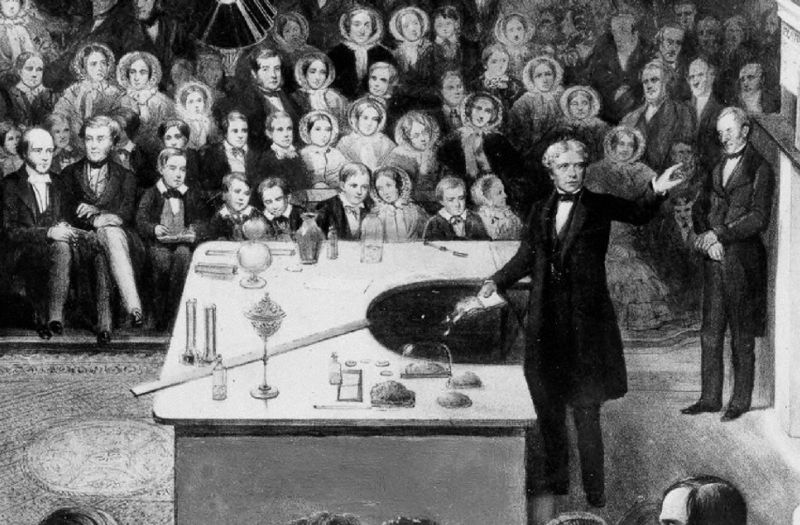
Michael Faraday at the Royal Institution

Finally, to time-travel backward just a bit, the artisan/philosopher connection was reinforced when the Royal Institution abandoned its plans for a separate stairway and entrance for the sweaty makers whose labors furnished the scientists with their instruments. The initial idea was to separate the artisans from the gentleman scientists. Thank goodness the Institution members thought twice, and thought better.

I spoke to this change of heart last January, in a talk at the Fashion Institute of Technology in New York City. The occasion was the opening faculty convocation at the beginning of the spring term. The topic for the entire year had been “Faculty of the Future,” though I think it could equally well be described as “Faculty for the Future.” My hosts were extremely warm and generous. The audience was perceptive and receptive. The State of the Union address just the night before, which I watched in “enhanced” mode on the Web as I sat in my NY hotel room, gave me some key insights to share the next day. And some credit-where-it’s-due there, as well, since my daughter Jenny was also watching that enhanced version, and used a Twitter backchannel to let me know she was right there with me on that meta-level of understanding. That knowledge, in turn, inspired me to further invention.

For the other truth about invention is a mystery: it feels singularly individual, and in many ways it is, but at the same time it is fostered most completely in a society of mutual respect and support. Like a family. Like a community of best-selves whose highest pitch of being emerges from a great whole. Like the Beatles. Like a fellowship of invention. With all the agitation about education these days, I sometimes feel like Frodo, who in his small but stubborn naivete insists that if we carry the ring, we will find the way.

With thanks, then, to my ace librarian Alice and my hashtag artist Jenny, here’s the talk I gave at F.I.T. in January, 2011.

Assessing Learning: A Response To John Fritz

My friend and colleague John Fritz commented on my last post at some length. My response to his comment grew and grew,  so I decided to make it a post instead.

I know you’re as passionate about these issues as I am, which is no doubt why your initial question comes out more like a peremptory challenge than an inquiry. Nevertheless, there are important issues here, and I will take a stab at speaking to them.

Of course I believe in evaluating the quality of student learning, both what they’ve learned and the conditions we imagine and provide to foster that learning. But now we’ve got not one but at least three things to assess:

  1. the student’s orientation toward learning (attitudinal, cultural, cognitive). One big difference between a rat in a Skinner box and a student in a learning environment is that the student brings memory, affect, expectation, etc. to the moment. What the cog-psy people call “appraisal” becomes crucial. And as Donald Norman points out, human beings infer intent and indeed the nature of other minds from the design of what they see and use. Schooling often sends very dismal messages indeed about the other minds who have designed such a deadening experience.
  2. what the student has learned–and now we have to think about what we mean by “learning.” Memorization? Insight? Creativity? Cross-domain transfer? “Going beyond what is given” [Bruner]? Mastery? Life-long self-directed learning and re-learning? All of the above? I choose “all of the above,” which means that “assessing student learning” must be complex, multi-source, longitudinal, and constantly revised in terms of what we educators are learning about brain science, learning environments, social aspects of learning, etc. etc. Doesn’t mean the assessments can’t be done, but I’ve yet to see an analytics paradigm that’s answerable to that complexity, and I suspect the paradigm itself is simply too limiting, too behaviorist in its model of mind.
  3. finally (or at least “finally for now”), we have to consider the very structures of schooling itself. While certain human concerns persist, or appear to (I’m not sure school really wants the disruption of true insight to dominate the experience, but maybe I’m just cynical this morning), the conditions and organization of schooling have changed over time, and not always for the better. Clark Kerr’s book The Uses of the University is very interesting in this regard. I also recommend, very highly, Seymour Papert’s The Children’s Machine, one of the most sensitive and poignant examinations of the uses of computers in education that I’ve ever read. Maybe *the* most. Right now I’m reading Norbert Wiener’s posthumously published Invention: The Care and Feeding of Ideas and learning a great deal from his thoughts on the technologies of education (including technologies such as funding, degrees, environments, etc. etc.). I just finished a fascinating article in Scientific American on “cognitive disinhibition” that suggests we should think about the role of disorder and eccentricity in education. The book Falling For Science: Objects In Mind also examines the oblique paths to deep learning, and the sometimes counter-intuitive ways in which the design of learning environments can encourage the learner to discover and explore those paths. I think also, with great admiration, of Chris Dede’s work on learning-as-bonding, and of Diane Ravitch’s newly awakened opposition to so-called high-stakes testing. For me, books and articles like these ought to frame the conversation. When I hear a speaker at a national conference say that supermarkets know more about their customers than schools know more about learners, I think the conversation is on the wrong foot altogether, and dangerously so. What a supermarket knows about my buying habits is not at all an apt analogy for what I want to know about my students’ developing cognition.

If you got the impression from my blog post that I don’t think we should assess student learning, please read the post again. The problem I mull over is the one that occupied Brigham: premature standardization and a “testing industry” (or, mutatis mutandi, an “analytics industry”) in which financial stimuli interrupt the necessary and messy process of ongoing research. Blackboard, for example, got enormously wealthy by giving higher ed a way to avoid dealing with the World Wide Web in any serious or innovative way. I remember being regaled with tales of improvements in everything from menu design to customer service while also listening to scornful commentary on “frills” like wikis, avatars in discussion boards, ingestion of RSS feeds, and of course all competing products. I also heard a lot about adoption rates, as if the very fact of widespread use was a reliable and complete measure of worth. As a sales technique, such talk was undeniably effective. As evidence of better opportunities for learning? Not so much.

Unless and until we acquire the patience, humility, and appetite for complexity that it takes to think and talk about learning, all other questions–allocating resources, evaluating teaching/learning technologies, etc.–are secondary. To assert a final answer to the question of resource allocation before we have suitably rich and complex questions about learning, let alone about assessing that learning, is to “do more widely those things that are now being done badly,” in my view. The huge danger is that resources will be allocated in the direction of anti-learning, or thin and superficial learning (they really amount to the same thing for me). For example: can we safely assume that grades in a course tell us everything we need to know about student learning, so that if grades go up, there’s been an improvement in learning? The grades tell us something, but what? And do they always tell us the same thing, across or even within a course? I don’t advocate eliminating grades as a measure of successful learning. I do advocate that we not design an entire system of assessing learning technologies around that single measure of success, when that measure itself begs so many questions about the nature and purpose and quality of learning.

On the macro scale, the degree completion stats also need more complex and nuanced thought, in my view. Reverse engineer it: if we find a way to nudge more students over the “C” line in more courses so that they pass the courses faster and thus finish the degree, what have we accomplished? Even if we assume that a “C” means the same thing in every class, and that a “C” is an acceptable outcome–and I do not assume these things by any means–what will we have when we have a nation of “college-educated” people who have squeaked by in factory-like classes based on memorize-and-repeat models of “learning” and “assessment”? Not the nation I’d want to live in.

The Internet has been transformational. College can be, too, but not by using metaphors of “management” in the way it thinks about fostering cognitive development. The honeymoon of edtech’s potential is almost over? What honeymoon? I don’t think higher education has progressed much farther in its relationship with interactive networked computing than awkward conversation on opposite ends of the sofa while the parents look on with disapproval.

“Analytics” interventions

I continue to marvel at Ellen Condliffe Lagemann’s An Elusive Science: The Troubling History of Educational Research. That book and Clark Kerr’s The Uses of the University (which I’ve now read twice) have been astonishing experiences for me this term. I wish I’d found them both earlier, but I’m glad I’ve found them now.

I wrote about Lagemann’s book in my last post. I want to continue with another, more focused look at a section called “Developmental Perspectives.” Here Lagemann tells the story of the rise of behaviorism as the fundamental paradigm of educational research, a paradigm that devolves into a kind of  “social bookkeeping.”  (The phrase immediately brings to mind some of the extremes in the new craze for web-based “analytics.”) Yet in that rise, even when it was happening, there were dissenting voices, warnings, even temporary halts in the headlong rush to reductive measures and models of human learning. One such warning came at the very moment the Educational Testing Service was about to be founded. As Lagemann tells the story, “the original proponents of such an organization were William S. Learned and Ben D. Wood, the directors of the Carnegie Foundation’s Pennsylvania Study.” They wanted to keep academic standards high, a laudable aim to be sure, but their models of cognition were narrow and simplistic. Like the miasma theorists in Steven Johnson’s The Ghost Map who thought cholera was caused by bad air, not water-borne bacteria, these experts were well-intentioned but working from a paradigm of fixed innate ability and stimulus-response learning whose basic assumptions were wrong.  We are still living with the dire consequences in many ways, including systems of educational “assessment” that use commodity methods to produce commodified learners.

Carl Brigham tried to intervene. He was not anti-testing. In fact, Lagemann tells us he was a psychometrician who had helped to develop the SAT and “was working to improve the SAT and other tests.” (More context: earlier in his career, Brigham had espoused racial theories of intelligence that he later disowned. Brigham’s break with his earlier views shaped many of the concerns he later expressed about uncritical adoption and use of standardized testing. You can read some of his story in this fascinating Frontline interview with Nicholas Lemann.)  What Brigham opposed was not testing, but a testing industry that encouraged schools to adopt these instruments uncritically and use them crudely, without an adequate understanding of the complexities of learning, particularly the social aspects of learning. Here’s how Lagemann describes Brigham’s effort, and his rationale:

In an article published in School and Society, as well as in correspondence with J. B. Conant, whom Learned and Wood had enlisted to help their cause, Brigham had expressed grave concern about two matters. The first was “premature standardization”–developing norms to give meaning to test results before the full significance of what had been tested was fully understood. The second concern was that there had been a lack of research into questions that were essential if tests were to be meaningful. As Brigham explained, “the literature of pedagogy is full of words and phrases such as  ‘reasoning,’ ‘the power to analyze,’ and ‘straight thinking,'” none of which is understood. Unless there was more research into such fundamental processes, Brigham insisted, testing would interfere with efforts to develop reasonable objectives for education [my emphasis]. Claiming that the demands of the market and the claims of  “educational politicians” had stunted the development of a valid science of education, Brigham feared that sales would overwhelm the research functions of a large permanent testing service. As he put it, “although the word research will be mentioned many times in its charter, the very creation of powerful machinery to do more widely those things that are now being done badly will stifle research, discourage new developments, and establish existing methods, and even existing tests, as the correct ones.”

Brigham’s words could have been written yesterday. His warnings are still urgent, perhaps even more so than when they were first written. Yet they haven’t been heeded, and the results have not been pretty, either. When Campbell’s Law kicks in, true insight disappears:

The more any quantitative social indicator is used for social decision-making, the more subject it will be to corruption pressures and the more apt it will be to distort and corrupt the social processes it is intended to monitor.

Under these circumstances, the “powerful machine to do more widely those things that are now being done badly” will also shape the entire schooling experience so lopsidedly that whatever the original test sought to measure, even imperfectly, can no longer be measured at all.  Instead,  the practices begin to measure themselves, untethered from complex realities, and to distort, even eliminate, the contexts in which deep learning can occur. Yet we will have self-validating data to make us feel we’re making progress, and a steady market for more feature-laden varieties of (proprietary) porcine lipstick.

Lagemann tells us that Brigham was right:  “the very existence of ETS helped perpetuate existing educational practices,” and “for a time turned scholarship in education away from the progressive purposes that had been so central to it during the interwar era.” The consequence was a shift from trying “to improve the effectiveness of instruction” toward the different goal of  “perfecting instruments of selection,” a shift that persisted until the “cognitive turn” of the 1960’s.

And now here we are in 2011, with a system that continues to appear to distinguish “academics” from “education.” Have we now come to the point in higher education at which the high-stakes testing world of NCLB and its kin, amplified by the worst models of computer-aided instruction, has concealed from us the choices we are making by selling us perfected instruments of selection in the guise of improved educational effectiveness? I often think so, and the thought frightens me. We’re being sold miasma meters to wave around instead of accepting the challenge of thinking hard about complex questions and designing our systems to be elastic enough to prevent the “vendor lock-in,” literal and metaphorical, of institutionally palatable patent medicines that will forever stunt our capacity for intellectual growth.

What could be more disastrous for a democracy?

The Heroism of Broad Problematics

Two books converged for me today: Edmund Morris’ Beethoven: The Universal Composer and Ellen Condliffe Lagemann’s An Elusive Science: The Troubling History Of Education Research.

Langemann writes movingly of the “early educationists” whose motivations were both “human” and “within the context of their era, comprehensible.” At the same time, she judges that their work bequeathed to the field of education “a sadly narrow problematics.” This is a much more precise way of saying what I often struggle to articulate: that much of the thinking I encounter surrounding schooling (with all that includes) simply reduces or denies the complexities of the questions at the heart of the endeavor. The “sadly narrow problematics” of the essentially behaviorist approach persists in many quarters, despite the famed and vital “cognitive turn” thinkers like Jerome Bruner encouraged and developed in the 1960s.

The haunting question for me, however, is why a sadly narrow problematics would emerge and be adopted in the first place, especially in the case of something as obviously delicate, complex, and relational as teaching and learning. Part of me remains genuinely puzzled by this question. Part of me is more sadly knowing. If one adopts a narrow problematics, one becomes more certain of the possibilities of useful action, more confident of the directions one should go in, more systematic and much less anxious about the daily work that advances the profession. Who wouldn’t want certainty, confidence, and clarity?

I do understand that desire. There are famous examples of what can happen when the problematics become so broad that the entire world is taken in as a problem. Apparently nutty and obsessive questions emerge: how many angels can dance on the head of a pin? Or a disingenuous career-enhancing “high theory” epistemological panic can enable one to write the same essay over and over, “deconstructing” (in the casual sense) everything, each argument spinning down into a self-consuming artifact, except for the artifact of the writer him or herself, magically exempt.

And in the meantime, there’s a kind of despair that settles in, as if one can’t know or do anything.

So yes, I understand the pragmatic realities, and I understand the need for operational integrity and managerial attentiveness (well, I am sometimes dubious of the way the latter is practiced, but I digress). But reading those words in Lagemann’s fascinating analysis, I wonder: if we’re encountering something as complex as the conceptual structures instantiated in neural connections and the capacity to stimulate and shape one’s own future neuroplasticity, and we narrow the problematics, isn’t that about the worst thing we could do? If all the targets of analysis and investigation are moving targets, we won’t get good answers or even good questions by pretending that many of them are stationary–or that we can demonstrate the success of our analysis by the way we triumphantly prove what we already knew going in.

Which brings me to the Beethoven, and the heroism of broad problematics. Last Sunday I was privileged to hear the Roanoke Symphony Orchestra in rehearsal with a massive choir as they prepared to perform Beethoven’s Ninth Symphony the following day. (Full disclosure: my sister-in-law sings in the chorus, but I don’t think that biases my response.) I know the Ninth pretty well. The second movement was the theme to The NBC Nightly News when I was growing up, and I always loved its wild, almost phantasmagorical mixture of echoing percussiveness and triumphant melody. Later, as I got to know the whole symphony, I was amazed by the confident depth of that haunting first movement, the beginning of which is almost nothing but a hint, followed by music of breathless insistence, a harbinger of the challenge we must rise to for the rest of the piece. Then there was the third movement, endlessly spinning out of itself with a melodic line that it seems to me leads directly to some of Shostakovich’s most heartbreaking themes.

But the finale is beyond even the abundance of what precedes it. The task Beethoven set himself was nothing compared to the task he set for us. We stand with the cherubim before God. We are all brothers and sisters. Our guide offers a kiss for the whole world. It would be ridiculous if it weren’t for the heroism of Beethoven’s joyously broad problematics, and the fact that he did it.

I suppose the approach to joyously broad problematics is the work of a lifetime: oblique, often disappointed, yet persistent, a unified and multiple embrace of complexity. To describe the project would be to dismiss it out of hand. Yet Beethoven accomplished it, and it cannot be undone. This kiss for the whole world.

I’ve sung that choral movement. I recall the first run-through with the orchestra. Our conductor, the late Paul Hill, smiled at us after he’d dropped his arms to his side. He’d seen this before, how inhabiting such a complex and urgent expressiveness would forever change our imagination of what could be experienced, what could be accomplished. Some work of noble note ere the end.

A broad problematics invites demagoguery, mystification, mental and spiritual exhaustion. Yet without it, no Ninth, no troth to plight under the wings of joy. No deep understanding. No deeply shared smiles.

Can the study of education, a technology to help us learn faster and more effectively, be guided by a joyful, heroically broad problematics?

How can it not be?

Video Games and Computer Holding Power

I so love this essay. As Jim points out, it’s unusually clear-eyed and fair-minded, and cuts the chase: at issue here is the human imagination itself. As Sherry notes, not only does Turkle have a superior first name, she even spells it correctly. Sherry also very beautifully connects video games with reading. While Sherry chooses reading for her full-scale immersion, the connection does point out both the enduring narrative aspects of gaming as well as the essential truth that we humans yearn for connected and connecting experiences of symbol-sharing and symbol-manipulation. In other words, stories, art, and creativity, those places where (what a sentence from Turkle–talk about nuggets!) “nothing is arbitrary and everything is possible.” And as Paige acutely observes, what’s at stake here is nothing less than mimesis itself, which means language, consciousness, community, civilization.

No pressure!

I think about my own relation to gaming, which began early in graduate school when pinball gave way to Stargate and Joust (ah, homecoming time at the Turkle essay) and others with exotic names I can’t quite remember anymore. Many quarters and much procrastination later, I gave it all up for stereos, computers, and movies. All with their own gamelike components, to be sure. And Jerome Bruner observes that all concepts have a gamelike structure, so I’m still well-implicated.

But the hard-core gaming experience went to my children, particularly to my son Ian, now 20 years old. That’s another story.

For now, I just want to register two nuggets from the Turkle essay. The first is on p. 510, and I was alerted to its peculiarly powerful resonance by a student in my first-year seminar. When she brought it up in class yesterday, I could feel the world going into freeze-frame, and then starting up again with much more vivid colors:

Video games allow Marty to feel swept away and in control, to have complete power and yet lose himself in somethign outside. The games combine a feeling of omnipotence and possession, they are a place for manipulation and surrender.

Nothing like a wash of oxymorons to get my pulses beating faster. And of course the word “possession” makes me flash onto one of my favorite books of all time.

The other nugget is one I’ve used in many presentations, and it too beautifully gets at that quality both Sherry T. and Sherry M. are thinking about, that realm where nothing is arbitrary and everything is possible–turned up to 11:

Recall Matthew, the five-year-old who was frightened by the idea that a computer program could go on forever–frightened and also fascinated. Things that give a sense of contact with the infinite are held apart as privileged. They become charged with emotion. They are often imbued with religious feeling. The feeling can be evoked by a sunset, a mountain, the sea. It can be evoked by mathematical experiences, the idea of the infinite sequence of decimals of pi, the sight of two mirrors reflecting each other.

I get such a case of the shivers at this point, recalling another favorite from another author with a great first name: “All art aspires to the condition of music.”

Bring it on.

Questions about the New Media Faculty-Staff Development Seminar

It’s been a thrilling albeit sometimes rough ride this term. I’ve learned a ton. The local group I’m privileged to be part of has gelled far beyond my expectations, and activity across the network has often been a wonder to behold, even in these early days and with sometimes very difficult situations emerging. But the seminar is a work in progress, of course, and there’s lots to tweak and think about. I’ve been in conversation with several folks about the tweaking and thinking, and one particular exchange was so rich that I thought I’d adapt it for a blog post. The result is largely from that one exchange, but with many things folded in from other conversations. I hope I haven’t misrepresented the exchanges in any way, or merely erected straw men to knock over. As always, I welcome and invite comments, if they’re civil. I won’t identify any of my conversational partners in what follows, as I haven’t asked permission to do so. But these are questions and ideas that did spring from real conversations–I’m not just making up interlocuters here.

I hope some of what follows is helpful or stimulating or both. It’s certainly long–no doubt, too long–but I thought the topic worth exploring at length. So here we go.

What’s the larger purpose of the seminar, and how can we get there? How much prescriptive and explicit “set-up” is necessary? How much open-ended “explore and invent” is possible when the readings are so complex?

I certainly want, as one colleague recently put it, to remove the fear barriers, open the doors, and create a runway for creativity. The question is how to do that. I’ve thought about that a lot, and for better or worse I have definite ideas. J For me, the key (as with all the work I do as a learner and teacher) is to work intensively with complex ideas that resonate both personally and socially (by which I also mean “culturally”). The ideas can be quite varied, and they can be expressed in different ways, but without them, there’s none of the deep synaptic work that in my view is necessary for genuine freedom and a new or renewed imagination. Then the question is how best to engage with ideas, especially when they’re complex. I feel very strongly that trust and conversation among spirited companions is the best way to engage with those ideas, especially when they’re new and complex and perhaps even off-putting, because in the end, trust among fellow learners opens the path to the next level. Or so I believe. I do also believe that guidance is necessary, however, and with several colleagues I’m now thinking about what form that guidance might take, and to what extent there should be explicit guidance.

Is the seminar merely flogging folks with hard technical readings the way we’ve flogged them in the past with technologies they don’t understand but are forced to adopt (e.g., “we will all now migrate to version x.x of software y—and no complaining!”)? Shouldn’t we find seductive ways to open minds and free imaginations instead of offering more impenetrable, painful experiences? Isn’t seduction (e.g., an iPad) better than flogging (e.g., requiring hard reading)?

Well, I hope flogging and seduction are not the only alternatives! I firmly believe in catching my flies with honey—that’s why God made honey-pots—but I want to suggest a third option: not flogging (bad extrinsic motivation—“the beatings will continue until morale improves,” and that sort of thing) or seduction (good extrinsic motivation that activates all the pleasure centers—hey, I enjoy that as much as anyone, believe me) but encouragement. Giving heart. Flogging suggests harsh paternalism and inspires resentment. There’s also a perverse pleasure in being flogged, as it allows one to escape any personal responsibility and blame it all (whatever “it” may be) on the Man, or the Woman, or the System, etc. Seduction sounds great by comparison, but it also evades the question of personal agency and plays into a “now, isn’t that *easy*?” paradigm that can be just as crippling as the leg-breaking. Not everything will be easy, not everything will be seductive, not everything presents itself immediately as fun. Some things are bound to seem or be strange or off-putting at first.

Take the universal experience of culture shock, for example. Yes, Steve Martin was right: they really *do* have a different word for everything in France. So what to do? Learning the language out of a phrase book is not fluency, but narrowly conceived utility. Learning the language with drill-and-kill memorization is similarly limiting. If all one wants to do is ask for directions, the first way will probably work as long as the directions are simple and straightforward. For real human complexity, though, it isn’t enough. The second way is also problematic, as Milton himself noted. (There’s my Milton reference for the day.) If all one wants to do is master the language in a limited way that does not engage with the real beauty of the language’s expressive capacity until very late in the game, by that time the student may simply have given up, or the capacity for real pleasure may be gone. I believe there is an encouraging way to do the hard work that does not take the big-picture expressive pleasure out of the experience even as there is unavoidably a steep learning curve—at least if one wants real fluency and an unfettered imagination.

But all of that brings into sharp focus the question of why one would want to “learn French” in the first place.Or to put it another way, why should we work hard to move our minds into bigger, messier, less certain, and less immediately comprehensible frameworks? For me, this whole New Media thing is that question, written larger and more comprehensively than anything before in human history. Ted Nelson says we can and must learn computers NOW. He wrote that in 1974. His essay makes it clear, I think, that it’s about expanding human capacity, augmenting intellect. His idea of “fantics” is wildly seductive to me, sure, but not because of ease of use. I don’t know if I’m explaining myself all that well. I guess I’m trying to say that the question of “what does it mean to learn computers?” is far larger and more urgent and more important than either the “flogging” or “seduction” can address. That said, I certainly think we can make the seminar more seductive through many means, cultural as well as technological (if there’s a real difference there, that is).

But aren’t these readings in The New Media Reader just stuff for techies? Can we really expect folks from traditional disciplines to work to understand them? What if people are just so turned off that they never come back? Don’t we risk simply making everyone defensive because they feel flogged by materials they don’t understand and don’t care about?

First, I’d want to challenge the assumptions implied in this question: that these essays are all “for techies,” that they’re all dry and difficult, and that people from traditional disciplines won’t find connections in there. My experience with the Baylor groups has been that some essays are more immediately accessible than others, but that there are connections in there for every discipline, for every role, for every learner, and that in finding and exploring those connections together (via those “nuggets” I always talk about, those points of resonance, puzzlement, or resistance) we become a true learning community. I really don’t think the situation is as dire as the question implies. This semester in particular, I’m seeing a truly astonishing blossoming of ideas and fellowship not only in the Baylor seminar but across the entire network. There are huge exceptions of course, but I never went into this thinking that the goal was a 100% yield. I’ve never been in a learning situation where that was the case, anyway. My goal is not to hit 100%, but to scale the experience (via the network, and over time) so that a critical mass of digitally awakened imaginations can begin to collaborate on the hard work of building, reforming, and augmenting education in the 21st century.

Perhaps some people do feel a bit bruised by some of the readings. It makes me unhappy to think so, but I’m sure some do. Well, here’s the deal, for me. If they feel flogged, how can we as fellow learners and, sometimes, guides help them not feel flogged? There’s a stark difference between being required to upgrade to Windows 7 or to lock one’s courses into Blackboard 8 or 9 or 15 or whatever and being encouraged to engage with ideas that are complex and suggestive enough to furnish mental models that truly liberate the digital imagination.  The question for me, then, is how to encourage people to engage carefully, openly, bravely, and joyously with new readings that are not necessarily in their “first” language, in terms of discipline or preference. But we know how to do that! We are teachers, after all, and we can do that for each other. The idea I have is that smart and curious folks working together can in fact equip themselves with a core set of ideas and conceptual frameworks that will empower them to think clearly, bravely, and innovatively about networked computing, the force that has enabled the largest increase in expressive capacity in the history of the human race.

Also, I don’t believe we will ever be able to craft any experience in which folks are not put off by something. If they feel they’re simply incapable of understanding the essays, in my view the problem is the feeling, not the reality. I firmly believe we *are* capable of understanding the essays. And I firmly believe that these ideas and conceptual frameworks are the ones we really should engage with—and that these essays (with some tweaking, sure; no syllabus is perfect or final) are the motherlode, the resonance frequency.

OK, but are we being innovative enough? Isn’t this just a 1930s-style graduate seminar that’s just enhanced somewhat by network technologies?

As my friends the edupunks know, I am not anti-tradition by any means. This experience is in fact, and unapologetically, modeled on a graduate seminar—but a graduate seminar in which there are no grades, no “deliverables,” just the responsibility and privilege of engaging with fellow learners, locally and remotely, in conversation about deep, rich, complex, and urgent ideas. And I do think that a face-to-face meeting at the local level is crucial to the success we want. So I really don’t think there’s anything wrong—and in fact I think there’s a lot right—because we’re doing something that’s based on a structure from earlier times (I’d say, at least since Socrates, or the Peripatetics). I also don’t see the seminar as being “just enhanced somewhat” by the ICT we use. I don’t see this as a small thing, a “just” thing. The networked design, the blogging, the Deliciousing, the tweeting, the forum (all of which is being used, to varying degrees, across the network) builds a platform and makes the intellectual activity visible. What folks build on that platform and how they respond to and contribute to that activity is up to them. That’s the beauty of it, and the challenge of it. I do agree, though, that I and we can do a better job of articulating the platform and explaining what the seminar can be, why the readings are there, what the experience may be like (including the side-effects, for some, of nausea and heartburn until we’ve gotten a few weeks in :).) My impulse is not to impose my own thoughts too strongly on the platform but to let folks discover it as they go, and invent new pieces that we can all learn from. This puts a huge burden on the individual group leaders (or facilitators, if you prefer).  We need to be in conversation more ourselves. I see that very clearly now. I’ve got some ideas in that regard. And I think all the seminarians, myself included, can and should work harder to encourage each other to blog, comment, and comment on other people’s blogs at other sites. It’s a lot to try to do in twelve weeks, but it’s worth doing.

But aren’t we still stuck in tech 101 by sitting in chairs and using printed books? Shouldn’t we be thinking about radically reshaped learning experiences?

I don’t agree with the assumptions underlying the question. Sitting at tables and discussing printed material is not just primitive, we-can’t-do-better, and unimaginative. It’s the core of building a local cohort dedicated to imagination and innovation. I don’t think the Internet makes the idea of local communities obsolete by any means. Rather it augments the local with the global—and vice-versa. Again, I don’t see the networked part as “just enhancing” something. I think the networked part makes the richly effective traditional face-to-face engagement into something that goes all the way to 11—something huge. I think that in fact it DOES radically reshape the learning experience. I think the radical nature is what’s putting people off, frankly. Cool tools ain’t radical. Getting early adopters or even long-time resisters together to geek out on seductive stuff isn’t radical. Workshops aren’t radical. Many times, even “course redesign” isn’t radical. What *is* radical is the idea of a seminar, unfettered by grades or projects or deliverables, networked so that the intellectual activity is visible and richly interactive. More on this below.

But isn’t blogging just another form of professional writing, one that strongly resembles the writing for professional journals we’re already used to?

Oh no! I’m actually dismayed to think anyone would think so. I think blogging is utterly (and radically) unlike writing for professional journals. Maybe part of the problem here is that folks don’t have a deeper understanding of blogging itself. It’s freer, looser, more voice-filled, more exploratory, more goofy, more fun, more multimodal. I’ve written for a number of professional journals, and blogging isn’t that at all—and shouldn’t be in this context either. It should be thoughts, scraps, false starts, stories of the progress of one’s own learning and missteps and questions and problem-finding…. The local seminar leader/facilitators should make these distinctions clear, I think—but that’s hard, I understand, unless one has some experience with blogging. Again, there is a certain amount of bootstrapping oneself into understanding that’s simply unavoidable (but can be fun, too).

I think the fact that blogging is utterly unlike writing for professional journals is one of the reasons it’s so hard for faculty to do (or at least to start doing). They feel lost and vulnerable without those professional journal structures. And they’ll say weird things to me like “who wants to read what *I* have to say?” This from people who are professors making their living from people who pay to hear what they have to say! No, I truly believe that blogging in this context should free us for authentic learning and sharing of our learning. I’m seeing that happen in the Baylor seminar, big time, partly through luck of the draw, partly through experience (I have the good fortune of being on my *second* iteration locally, and fifth in terms of the undergrad class, so I’ve got more mistakes of my own to learn from), and partly because of another part of the “networking” I kind of backed into this time: teaching the first-year seminar at the same time as the faculty-staff seminar. *That*’s been extremely interesting and suggests models of education that are well worth exploring in more detail, particularly as the two groups begin to interact. This too could scale in interesting ways.

But we’re still conscious of our audiences, just the way we are when we write for professional journals. The only thing that’s really different here is the speed of publishing and interaction.

I don’t think this is right. There is no writing that does not involve consciousness of audience, so we’ll leave that aside. The difference here is not simply speed. It’s that the entire process of the blogosphere is wired differently, with trackbacks and comments and aggregation, etc. One PSU person commented on the forum that all this talk of trackbacks and so forth sounded like mere logistics. I understand why that person might think so, but that’s precisely the opposite of the point (and I certainly need to do a better job of explaining why). In New Media, webby logistics shape and extend content, and thus change the conditions and possibilities of content, and thus begin to alter our notions of what counts as content and how we will create it. The medium is the message. A link is not just a technical contrivance. It represents something new in terms of implicit and powerful citation/association, something that’s as much a game-changer as the alphabet. If trackbacks are logistics, so is language itself. Similarly, blogs furnish a very different model of peer review, what Shirky terms publish-then-filter, instead of the traditional filter-then-publish. When one begins to understand those possibilities, to assemble a network of filters and amplifiers (Udell) that make that system sing, one finds a huge and powerful set of differences between blogging and sending an article to a professional journal that goes well beyond speed. No peer review. Built in comment affordances. Permalinks. Trackbacks. Feeds. Aggregations. Embedded images and video and audio. One can commit art in a blog, and should!

The more I’ve experimented with this seminar, the more it has been growing on me that blogging represents something fundamental that needs to be more widely and deeply understood. I actually spent a little more time on that with my group at Baylor this year, and it seems to have paid off very well. So this may be another area to push forward. Believe me, it’s radical!

Are you saying that more creatively social approaches are unnecessary in this seminar?

Not at all. There’s room for much growth and improvement here. This first iteration of the networked seminar makes that clear to me. And of course that’s one reason the maiden voyage is so important. I agree we need to work the social aspect much more vigorously—but I still maintain blogging will be a key part of the platform we build.

But is blogging really social and interactive? Can’t we explore more interactive tools?

We should always explore, certainly. No problem there. But again, I want to unpack the assumptions a bit. Blogging can be highly interactive and social. It’s built to be that way. It certainly has been interactive and social in my experience, profoundly so. But it does demand commitment far beyond Foursquare check-ins (not that there’s anything wrong with that). It demands deep intellectual engagement. And I believe that only deep intellectual engagement can move us in a positive direction, away from what is so often the witless or flogged technology practices we’ve seen in higher ed.

And here’s another thing I think about: why is “deep intellectual engagement” of this kind something so difficult to get going in higher ed? Does anyone see anything wrong with this picture? 🙂 Where’s our curiosity and spirit of adventure? We ask so much of our students, but it’s hard for us to write two or three paragraphs about something *we’re* learning, to be that open and curious and wondering and vulnerable. See, that’s the radical idea … that we should learn in front of each other.

Well, what if instead of reading Ted Nelson, we explore Xanadu virtually, for instance.

GC: In *addition to*, sure. The Baylor facilitators that day actually played for us a video of Nelson explaining Xanadu, and doing that was both stimulating and helpful. I feel strongly that seminarians should bring some kind of interesting new media into every session. We’ve certainly tried to do that at Baylor. But why *instead of*? In my view, we could explore Xanadu all day, but unless we’ve read the impassioned and provocative excerpts from Nelson’s manifesto, the experience will be superficial, weightless—just another interesting tech demo. We’ve had enough of these, and they just don’t change anything.

And for most of the folks who blogged about it, Nelson’s essay was easy to read–even fun. Folks enjoyed his spicy rhetoric. I’m not sure the problem is spice. But the readings need to be framed and experienced as vital, deep explorations of essential challenging ideas. I think that’s not only possible, but necessary. The book and essays are the platform. Build the social stuff on and through and around it, yes, but at the end of the day, if we want to know where Nelson is coming from, his crazy multimodal manifesto is the foundation. And it can be fun—and is for many people, potentially for everyone if they just relax and go with it!

Shouldn’t we be modeling the kind of pedagogical innovation we want to bring to our undergraduates? Are reading and conversation really innovation in terms of a course of study?

GC: This isn’t a “course” in that sense—at least, as I’m struggling to articulate it. It’s more like a reading group on steroids, a deep conversation, a think tank, a set of community activists in fellowship. No doubt we can mix the experience up more to help the readings come alive for folks who are struggling to get their imaginations awake in that medium. But the idea is not to leave the medium of the essays behind—it’s to *augment* them, and by augmenting them, to awaken our digital imaginations.

I’m confident that NMFS is not the only way to do it. But I’m also confident that it’s never really been tried like this. And I’ve seen such rich results from my undergrads and now from my colleagues at Baylor that I think the thing to tweak is not the basic philosophy of the seminar, but the ways in which we can mindfully work together to make that experience as rich as possible. Remember that it was an *undergraduate* class that led to the NMFS. In many respects, one of my primary goals with this experiment is to model the idea of the *seminar* in a purer and less encumbered way than one typically finds it in higher ed. My experience has been that a seminar like this is pretty radical for the undergrads too—we talk about this with some frequency.

For me at this point, the problem is not the idea of a seminar, it’s that the idea of a seminar has become corroded and compromised by all the clanking of the industrialized model of schooling. A real seminar, where we’re all learning together, where we’re all bootstrapping and augmenting ourselves into a fuller level of understanding, is highly innovative in a world of grades, semesters, products, GPAs, credit hours, etc. Or so it seems to me!

I guess we’re learning as we go, as guinea pigs for each other. We’ll press onward through the fog.

Part of any learning experience is watching the fog lift. Some weeks are foggier than others. I felt foggy last week. Not so much this week. Here’s one huge reason why: http://homepages.baylor.edu/lance_grigsby/what-we-behold-becomes-us-too/. I really do think the blogging is key. A good motherblog is key. Recirculating/aggregating/displaying comments. Being explicit about what a blog is and how it works and what it can be and can mean. It’s the whole package. I agree wholeheartedly that we need to be more explicit and have deeper conversations about how all this augmenting is designed. Maybe the local leaders/facilitators need to be in intensive conversation for two or three days before the next iteration. In fact, I think that’s a great idea (and I’m very grateful to the colleague who suggested it). We really do need to understand the platform at the outset, so we can share it with confidence with each of the local groups. I think about the Center for Digital Storytelling in this regard—they’ve got this “train the trainers” thing down cold.

And hey, if folks want to do their own thing, that’s fine—that’s what was happening before any of this started. But I have to say that I am firm in my conviction that we need to be in *idea space* (Kay) and the way to get there most deeply is by reading and talking about and blogging about these essays, augmented by all the new media wonderfulness we can muster. Without that depth, we just won’t get the traction we need. Without that traction, we can’t move toward the change or reformation we desire.

Free, as in Unfettered

I do many presentations these days centered around the idea of openness and the value of teaching ourselves and our students the ways and means of digital citizenship, which for me inevitably includes publication to the open Web (there’s that “open” thing again) and subscribing (RSS or otherwise) to material published to the open Web. That’s why it’s the Read/Write Web.

Clearly my ideas have been influenced–I’d say “shaped” is more like it–by the resonance frequencies of Bush-Licklider-Engelbart-Nelson-Kay et al. As several folks have pointed out in the Baylor seminar, that resonance frequency is also present in McLuhan and in today’s reading, Bill Viola’s “Will There Be Condominiums In Data Space”? I confess: I chose the readings and ordered them as I did to find and amplify that resonance frequency. For me, it’s the music of the spheres, not just because *I* like it, though I do, but because it sets in motion complex individual resonances that lead, I firmly believe, to the imaginative leaps and awakenings that we need to make sense and use of our digital world (and perhaps our world, period–though they’re rapidly becoming synonymous).

Prepping for today’s New Media Faculty-Staff Development Seminar meeting, I re-read Viola. I re-read him yesterday too as I prepped for the First Year Seminar meeting. Each time I marveled even more at the extraordinary range and depth and quality of his thought.. His commitment to convergence-divergence, or is it divergence-convergence, is breathtaking, even if he sometimes doesn’t quite get the science entirely right (Hillary is characteristically on point in her critique but also characteristically generous in her final appraisal). He really is someone with McLuhan’s heart who also makes the kind of art Errol Morris makes, as Paige brilliantly notes, in which whole and part dance together in a wonderfully delicate yet amazingly powerful quodlibet. Or perhaps it’s a foxtrot, or a minuet. But I digress.

I hadn’t quite finished my Health Camp meal when I finished re-reading the Viola. I meditated for a bit, then flipped through the pages of the New Media Reader in search of another interesting nugget. I was, frankly, in the mood for a manifesto. I saw Haraway’s famous “Cyborg Manifesto,” but that was too direct for me at that moment, the glass of Dublin Dr. Pepper still half full. I wanted something stranger, or less direct. So I went to the next manifesto, on the very next page: “The GNU Manifesto.” I had a nodding acquaintance with the topic, and I was intrigued, since “open” as in “open source” has been a big topic of conversation at my workplace lately.

And then the tumblers aligned, the key turned into the lock, and the scales fell from my eyes:

Since “free” refers to freedom, not to price, there is no contradiction between selling copies and free software…. Because of the ambiguity of “free,” people have long looked for alternatives, but no one has found a suitable alternative. The English language has more words and nuances than any other, but it lacks a simple, unambiguous word that means “free,” as in freedom–“unfettered” being the word that comes closest in meaning. Such alternatives as “liberated,” “freedom” and “open” have either the wrong meaning or some other disadvantage.

And that was in a sidebar, quoted from “The GNU Operating System and the Free Software Movement,” by Richard Stallman, also the author of the Manifesto. It pays to check everything: sidebars, captions, titles, epigraphs, copyright pages, acknowledgements, dedications, even the little SDG at the bottom of Bach’s scores….

So I’m thinking today that the kind of education I want to support, and to co-create, is unfettered learning. The trick is to understand when open means unfettered, and when it might be a closed platform that sets us free (and I mean in terms of learning, NOT in terms of copyright. The copyright “protection” of closed LMS’s is actually one of those weakening prosthetics, as it keeps us from agitating vigorously for our Fair Use rights and keeps the current copyright jailers in the money). When does a curriculum unfetter us, and when is it a set of handcuffs? When does a teacher unfetter us? When do our classmates unfetter us? A classroom, or a credit hour system, or an advising system? And so forth. These are very difficult questions indeed, and of course some oppressors believe most sincerely (it seems) that they’re keeping handcuffs on for the inmates’ own good–and of course Stockholm Syndrome means that sometimes people don’t want to lose their fetters, so thoroughly do they identify with their captors.

But these are the complications we should confront continually, lest we fetter ourselves and others. Kierkegaard tells us that the worst despair is not to know you’re in despair. Blake anticipates Kierkegaard’s aphorism by calling the worst fetters “mind-forged manacles.”

In every voice, in every ban,
The mind-forg’d manacles I hear.

Only the awakened imagination can make us aware of those mind-forg’d manacles, let alone help us to slip their bonds and help to free our colleagues and fellow pilgrims. Let alone help us desist from creating them for others, among them, horribile dictu, even at times our best beloveds. I take it that that’s why Blake was a poet, that’s why Bill Viola does his art. But that’s also why scientists labor to uncover new knowledge, and talk so passionately–and imaginatively!–to their colleagues and to all of us about the scale, scope, and importance (and excitement!) of their work. For we are all imagineers, and we are all in this together….

And while Pete Townshend was right that there’s no easy way to be free, loosing fetters and creating portals to realms of greater unfetteredness for all is, I believe, one of the highest, noblest, trickiest, most exhilarating aspects of this thing we call, simply, education.

In my experience, no human invention has had greater potential for that unfettering than the Internet itself. The pub-sub model that Jon Udell describes in the podcast I linked to in my previous post is right on target about how that can and should happen. That the Internet also has the opposite potential (and that’s what we hear the most about, unfortunately–man bites dog and uploads video to YouTube) should surprise no one. Every powerful human invention cuts both ways. But that’s the bad news and the good news too. Both ways. And I suppose we have some say in the matter, if we can loose the mind-forg’d manacles that keep us from the freedom of the Internet itself….

Awaken the digital imagination, then strengthen the heart, hands, and mind for digital citizenship.

In that spirit, then, I offer a podcast recording of my keynote talk last Friday at the E-Learn 2010 conference. I called it “The Great Internet Backlash,” and through that lens I viewed what seem to me to be both the manacles and the possibilities for unlocking them. I believe I am right, but I am not sure of it. That’s why I want to keep this conversation going.

Conference website: http://www.aace.org/conf/elearn/speakers/default.htm

Archive of the talk with PPT slides: coming soon, I hope.

And here’s the recording I made. I hope it resonates. Let me know.

The global nervous system worked like a champ

One view of conceptacularity

I’m exhausted, so I won’t be able to do anything like even the most superficial justice to the experience–but I want to note it now, before this magic moment subsides.

I’m at OpenEdTech 2010, sponsored by the Open University of Catalonia. For the last two and a half days, thirty educators from around the world (India to Canada to the US to Spain to Jamaica–you get the idea) have been working, laughing, cooking, eating, and dreaming together about how we might help to build online learning spaces that support and inspire the joy of learning. We seek to co-create online learning spaces that are just as memorable and magical as those places on a physical campus that embed themselves into our experience and weave themselves into the texture of *alma mater*.

We just had our summary session. Tonight we will eat together once more, then disperse to our scattered homes. But not quite yet. There’s time for one more reflective journey before the miles come between our company.

As we were finishing the last intensive bit of group work before that summary session, I suddenly knew what I must do. I must contact my young colleagues at Baylor. These colleagues, as fine a conceptacular crew as one could wish for, had a perspective on this “joy of learning” question that simply must be part of our discussion in Barcelona. So I set about convening them, virtually, and put the question to them for their consideration and expression.

As a result, ten of the eleven students in the class (yes, students are my colleagues, and each others’–at least, that’s been my experience for twenty years) blogged their responses to the question. They were thoughtful, playful, energized, focused, imaginative. Our work together in the New Media Seminar had prepared them well to think about online learning in large terms, a la Engelbart, V. Bush, Nelson, etc. They made fascinating distinctions and ingenious suggestions. They got superbly artful with their linking (one strong mark of a master blogger, in my view). The quest was on. And mirabile dictu, they began commenting on each other’s blog posts just about as quickly as they could be written. They built out stunning examples of how individual depth and social breadth could also, and very quickly, become individual breadth and social depth. E pluribus unum–and the reverse, however that might look in Latin. 🙂

And then I shared the responses with my colleagues in the room in Barcelona, half a world away, yet intimately connected in the global nervous system Jon Udell so eloquently describes in this podcast. The room got very quiet. It was magical.

I confess to you: I love my colleagues, my students, my conceptacular fellow-travelers. I love how quickly they responded, how well they entered into the sustained conversation, how they conversed with me and each other and, today, the world. I am proud to be among them.

If you’re of a mind, please visit their blogs and leave some comments. Comment love, we call it, and not idly, either. Start with our motherblog to get the range of the conversation. Then click over to the individual blogs, listed here, to interact with the posts my colleagues contributed on this very special day:

The first time I saw the mother of all demos, indeed the first time I read Engelbart, I quickly intuited that days like today were made possible by his vision. More than that, I somehow understood–I honestly don’t know how–that days like today would be part of that same dream of augmentation, that dream of how the world could be that I first brushed against when I read of life in an integrated domain and the conceptual framework that could make it possible, even likely. This is my experience, no doubt not shared by all, but undeniably part of the fabric of which I continue to be woven. That noosphere Engelbart and others saw on the distant horizon, the summation that Jon describes so very beautifully and urgently, is ours for the asking, now.

So why not ask for it? No, that’s not strong enough. Why not insist on it? Look at my young colleagues’ work and the joy that carries it aloft like sweet incense. Can we not answer that joy with open hearts and minds of our own?

The Arts of Augmentation

It’s been quite a week since last Wednesday’s New Media seminar at Baylor. The seminar meeting itself was an extraordinary session, as Christina Engelbart, Executive Director of the Doug Engelbart Institute, joined us via Skype to discuss the many facets of her father’s work and the Institute’s ongoing mission. Christina’s contributions were warm, direct, and clear throughout. Several participants remarked how much better they understood her father’s conceptual framework as she explained it. Christina’s great gift for connection came across very compellingly through that Skype window. There we were: she in her house, and we in our seminar room, our company knit closely by a version of the very affordances her father had imagined and helped to bring into being all those years ago. The effect was uncanny, especially as we had begun the session with the clip from the end of “The Mother of all Demos” in which Doug Engelbart thanks his team for their support and dedicates the entire demonstration to his family, the loved ones who for as long as seventeen years had endured his “monomaniacal” commitment to augmenting human intellect. Moving from that digitized movie on YouTube to our conversation with Christina via Skype, all displayed on a flat panel LCD screen at the side of the room fed by a Mac mini controlled wirelessly by a keyboard and mouse—well, it was a richly recursive experience in what sometimes seemed to be a time machine connecting us to the past, and at other moments seemed to be a time machine connecting us to the future.

The key is connection, of course. Christina reminded us that for her father, the technology was always a means to an end, and the end was always collaborating and communicating in a way that would bring our collective IQ into the fullest range of its expression and usefulness. Otherwise, we cannot possibly address the complex, urgent problems we face as a species, nor will we ever realize the enormous potential we have for learning, creating, and sharing.  Without a strong, committed co-evolution between us and our tools, especially the tools represented by the promise of interactive computing, we’ll be forever distracted by our “isolated clever tricks that help in particular situations,” and never attain the “integrated domain” of which Doug writes so movingly in the opening of his seminal “Augmenting Human Intellect: A Conceptual Framework.”

In the blogs around the seminar meeting, at Baylor and elsewhere, and in the discussion at the Baylor meeting as well as at Tulane on Friday (I was privileged to be their guest facilitator), many folks commented on how difficult and dense they find “Augmenting Human Intellect.” Some speculated the difficulty comes from Engelbart’s engineering background. Some were troubled by the way Engelbart switches from first-person to third-person as he tells the story of “Joe” trying to tell the story of the augmentation framework. Still others remarked that Engelbart seems naïve about the various power agendas that motivate human beings and block real collaboration.

When she spoke with the Baylor seminar, Christina Engelbart emphasized that her father had written “Augmenting Human Intellect” pretty much in isolation, as he had been strongly warned against sharing these ideas with anyone, lest he be thought crazy. (There’s an irony as well as a paradox in Engelbart’s isolated writing—more to consider there.) Many did think Engelbart a “crackpot” for many years until the Mother of All Demos—and the future it pointed toward—showed that Engelbart was not only sane but indeed a towering visionary. It’s never easy to sum up a decade’s worth of thought, especially when that thought has seemed dangerous to utter.

But now it’s time for a confession. When folks ask me if I, too, find the essay difficult, I usually mumble some kind of assent out of fellow feeling. Yes, I do find it a challenging piece of writing—but no more so than Milton, or Shakespeare, or Woolf, or Faulkner, or Joyce. In fact, in its complexity and playfulness, “Augmenting Human Intellect” resonates with me very strongly as a work of art, even a work of philosophy. I can’t claim to have gotten to the bottom of it. Perhaps I never will. Art is like that. But I rejoice in it, and enjoy the many wry twists and turns of rhetoric and storytelling Engelbart employs. (Christina spoke movingly of her father’s gift for storytelling, and how her childhood friends ask her if he’s still telling those stories.) For me, the idea of working collaboratively within the structure of a concept and all its associative trails is positively thrilling, and Engelbart describes it so vividly that I cannot help believing it can truly happen at the scale and with the fluency he imagines. When I compare his vision to the reality of most of the meetings I participate in during the course of a normal week, well, there’s really no comparison. We’ve devised so many methods for de-augmenting our work together that one would almost think we actually prefer a state of de-augmentation. Engelbart’s hope lifts my spirits and strengthens my resolve that we can do better.

And if it all boils down to hegemonies and power games, and collaboration is always already a mask for overtaking the other, then permit me my callow hopes. The sophisticated, brittle, cynical alternatives don’t much interest me. No nourishment there.

When I read “Augmenting Human Intellect,” beginning with that astonishing first paragraph on the integrated domain, I feel I am reading one of the great humanist essays of our time. My confession for you is that the real difficulty I feel is not in reading the essay. It’s in measuring up to its deeply felt humanity.